A common mistake I see product designers make is that they start the solution exploration phase by cobbling together UIs out of the components and patterns in their design system (often skipping lo-fi, broad explorations, which is a separate rant [and one that Figma makes far too tempting with its shared libraries #endrant]).
“But I want to be consistent with the rest of our product! Shouldn’t I be using existing components and patterns? Why is that bad?” I hear you protesting.
I applaud your instinct 👏 It’s coming from a good place. But don’t do it. You’re artificially constraining the solution space before you’ve found the best design for the specific problem you’re trying to solve. You’re potentially overlooking better options by only using what currently exists.
“So what do I do? Ignore the design system altogether?”
No, that would make the design system pointless, wouldn’t it? But actually, yes — kind of. The proper time to reach for the components in your design system at the end of solution exploration, when you’ve nailed down the interactions and flows, have validated it with customers, and your team is ready for you to create the final hi-fi designs for engineers to build.
At that point you can take what you have (which should be mid-fi at most), and seek out the components that most closely match what’s in your designs. A mature, robust design system should have components for the majority of the UIs you create. There may be some things that you did slightly differently than the standard component, and you can adjust your design to fit what exists with little to no impact to the usability of your feature.
“But what if there is no component that meets my need?” Now this is where things get interesting. In this case, you should go to your design systems team to get their input on your designs.
First, confirm that you didn’t overlook or misunderstand anything in the system. It’s possible there’s a component you should use, which the team can educate you on.
Assuming there is no component you can use, you can now work with the team to determine next steps. There are 2 options here: either your thing is a snowflake (i.e. it isn’t a generalizable component that can be used elsewhere), in which case your team can build it as part of the feature; or, the design system needs to be extended.
If it’s the latter, congratulations! You have a contribution to the design system. You have a specific use case for a component or pattern for a feature that’s been validated with real users, and no known equivalent in the existing system. You can work with the design systems team to flesh it out into a generalized pattern.
Design systems are meant to be living systems that grow and change as products grow and change (in my opinion. Some people may think they’re a tightly controlled system that everyone should conform to, but those people are wrong). The best way for them to grow is organically — meaning through contributions from specific features that identify gaps in the current system. Not from hypothetical, “I saw this pattern in Material Design and thought it would be cool to add to our system…”
So there you have it! Next time you’re entering the solution exploration phase and you feel the instinct to reach for your Figma component library, STOP! 🛑 ✋ 🙅. Do not pass go. Do not collect $200. Start with as few constraints as possible and explore broadly before honing in on the best solution. Only then should you translate what you have into the design language provided by your design system.
Last fall, Optimizely was acquired by Episerver, signaling the official end of Optimizely as I knew it. I’ve been re-connecting with old Optinauts and reminiscing on the magic of those early days.
I joined the company in 2012 as employee 29. It was pre-series A, everyone fit in 1 office in downtown SF, and the average age of employees was about 27. Not too long after joining we had the 4th highest valuation of all YCombinator-backed companies (behind AirBnB, Dropbox, and Stripe). There was a ton of energy and momentum behind us. We were all young and hungry and full of ideas and eager to prove ourselves. We had a lot of freedom to try out ideas, fail, learn, and grow. It launched the careers of most of the people who were there, including mine.
What follows are a collection of my most cherished memories.
Every Friday afternoon was Show-and-Tell. We were small enough for everyone to gather together around a couple of couches, grab beers, and plug in our laptops to show what we’d worked on that week. Engineering, design, marketing, sales, success — everyone just showed stuff. There wasn’t a format or agenda, really. It was just show-and-tell :)
That would transition into more beers and people hanging out and playing ping pong, Starcraft, poker, whatever. It would just turn into a party. That would often transition into ordering food or going to bars. The company was young and unencumbered with responsibility, plus a lot of people were new to SF, so the conditions were right for our work lives and social lives to blend together.
I remember the week I joined, we had a happy hour at House of Shields, the bar on the ground floor of the office. A candidate was interviewing for a Solutions Architect role, so we invited them to join us for the happy hour. Dan, the CEO, convinced them to sign our offer on the bar. Literally, on the bar.
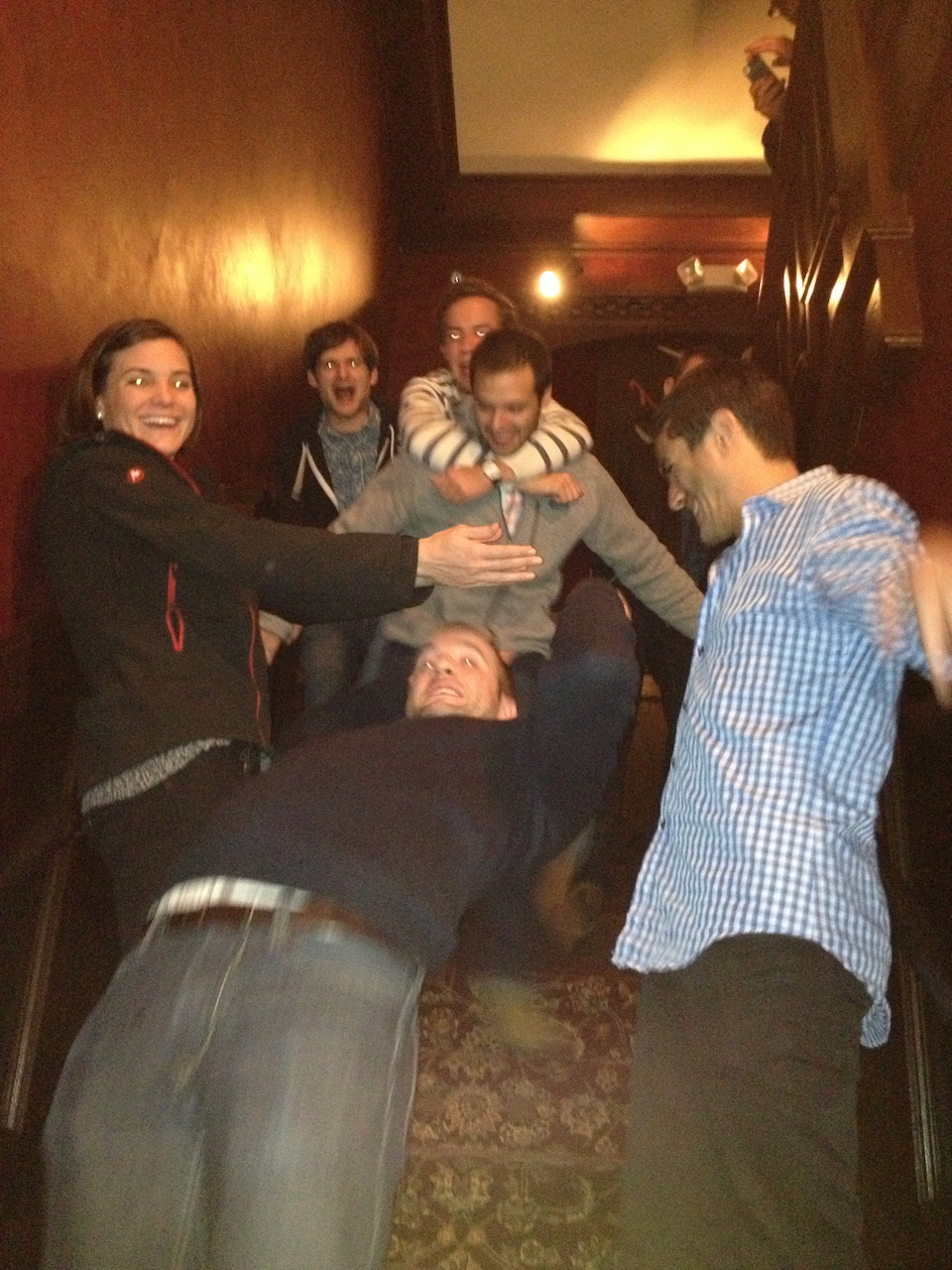
A couple of months after I joined, we had our first company retreat to Santa Cruz. There were maybe 40 of us total. We stayed at the Dream Inn, right on the beach. The bus ride down was a party, with everyone drinking and enjoying each other’s company. We had some sessions about plans for the coming year, but most of it was just having fun. I can remember everyone getting sloshed at the company dinner, then getting more drinks at a bar, trying to break into the jacuzzi long after it had closed, running out to the beach instead, getting yelled at from the balcony of a room which turned out to be the after-after party in the CEOs room, which we then joined to keep drinking. I was still quite new and just amazed at how fun the people and culture were.
Drunken photo of us in Santa Cruz
On the Sunday we were returning, most people (including me) were tired and hungover and slept on the ride home. But not the CEO. He got a 30 pack of Coors and kept drinking with the sales team the whole ride home.
The following year we had our second (and I believe final) company retreat to Tahoe. It felt just as fun and collegiate as the first. My main memory from that trip was one person broke their back skiing (same person who signed their offer on the bar at House of Shields). He had to be airlifted to a hospital in Reno. One of the co-founders stayed with him until his parents arrived.
At some point we ran out of room of that first office. I can remember squeezing desks into every corner of the office and there being just enough space to walk past each other. Eventually we rented a second office nearby and moved sales there temporarily. (Which I seem to recall turned into a frat house).
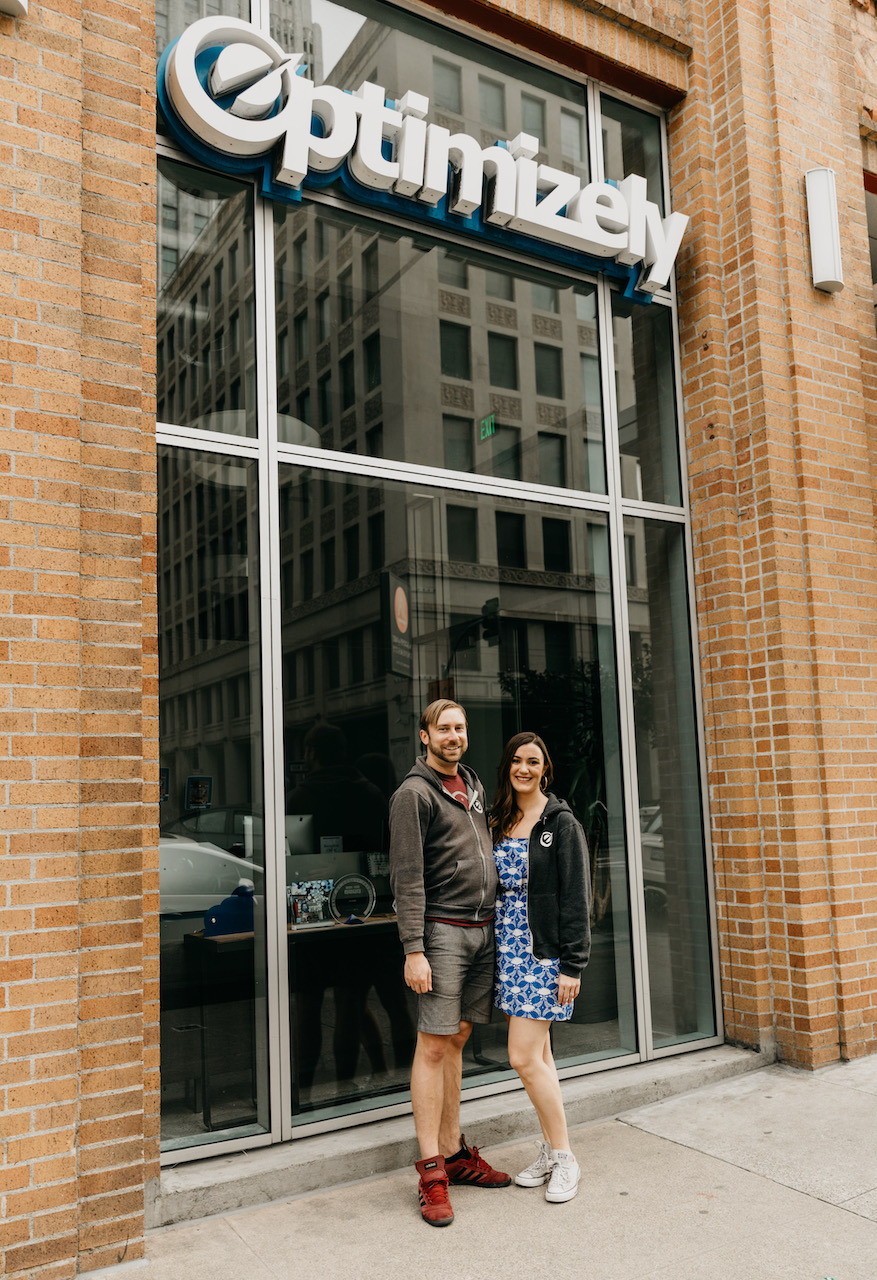
When we finally did find a new office space big enough to re-unite the company (the space on Howard that Optimizely was most well known for), we were all so excited to move in. It had tons of space. Downstairs was dedicated to lunch, show-and-tell, 3 kegs, a speakeasy (which ended up not getting built), and games (we had 2 ping pong tables, a ping pong robot, and a foosball table). No desks or conference rooms. The first floor was sales, marketing, and success, and the mezzanine area was for product, engineering, and design. We quickly expanded into the 3rd, 4th, and 5th floors. (Although I don’t think we ever occupied all of them at the same time).
My wife and I in front of the new Optimizely office (this is from our engagement shoot)
I can remember going to the office on a Saturday to help set it up for our first day that Monday. Getting desks ready, organizing the kitchen, that type stuff. We made little welcome gifts for everyone that included an Optimizely branded pint glass, some swag, candy, and a few other things. It all felt very exciting and like we were on an unstoppable growth trajectory. (I still have the pint glass).
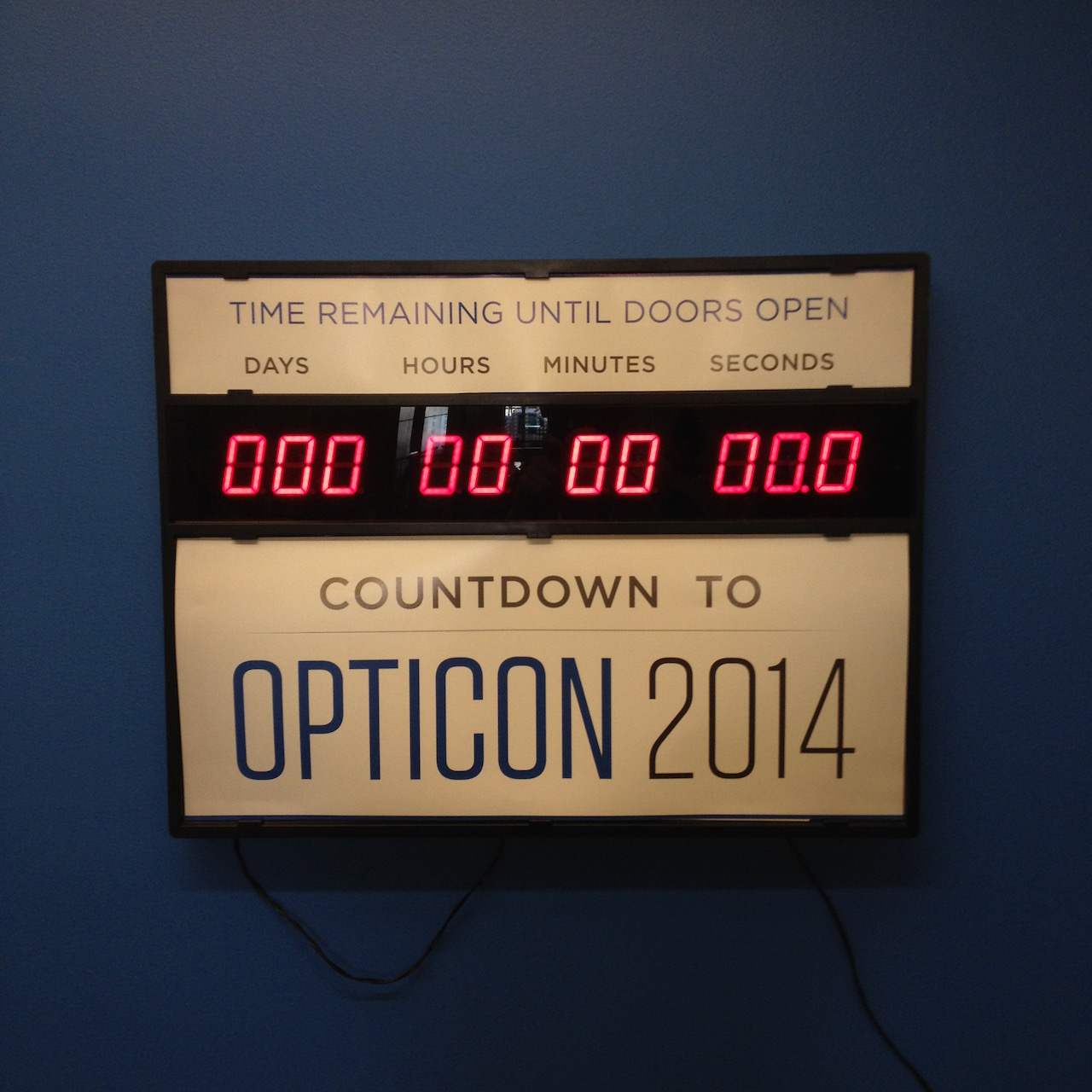
In April of 2014, we had our first annual user conference, Opticon. It was on the top floor of the Metreon, in a cluster of small conference rooms. Only a few hundred people attended, which felt huge at the time. It was so electrifying. The whole company worked hard to pull it off — planning and marketing the event, booking speakers, building features to announce, and so on. It was only one day, but the whole week felt like a big celebration. Customers were jazzed. We were jazzed. I remember going back and forth between there and the office and just having a ball hanging out with customers and coworkers.
Countdown to the first Opticon
The next Opticon was at the cruise ship terminal, and expanded to two days and closer to a thousand people (I think. I’m going off of memory here). It was everything the first one was, but bigger and better. We were firing on all cylinders — the product was doing great, customers loved us, and revenue was strong.
Opticon’s main stage, where we announced Personalization
That early design team also had a magic about it that I haven’t been able to re-create since. When I joined, there was one full time designer, and one contract designer who worked full-time hours. I wasn’t technically on the design team (I started as a frontend engineer), but I spent all my time with the 2 designers.
Then we expanded by hiring a researcher. I suggested this, and the full-time designer got the req opened (I don’t remember there being any push back). In retrospect, it was way too early for a researcher. But somehow we found a great one with a ton of experience from Salesforce. Why she decided to join this rag-tag group of young, inexperienced designers is a mystery to me, but we were all thrilled she did.
The original D-team 4
I remember shortly after we hired her there were a couple of designers we were considering making offers to. She asked (and remember, she came from Salesforce and, thus, was the most experienced member of the team), “How much headcount do we have?” And the full-time design/design manager responded, “We don’t have a fixed headcount. We just hire good people on a rolling basis.” Which is just insane! But at the time I didn’t see anything wrong with it. Looking back, it’s not a smart way to run a business. The company of course grew in lopsided ways and added roles that we didn’t need long term, and had layoffs a couple of years later, but at the time I thought it was incredible.
From there we tried to hire more product designers, but it was really hard. We interviewed a ton of people and a lot weren’t any good, and then the first few we made offers to all declined us. At the time I thought they were crazy, but looking back it’s clear why: we were all super inexperienced and had no idea what we were doing, which is obvious to anyone who’s worked at a more established team.
Early design team lunch
But once we got going, we hired a killer team. We ballooned to 20 product designers, UI engineers, communication designers, and researchers within about 2 years. That early design team had an inexplicable camaraderie and joy and closeness to it. A lot of them came to my wedding.
I’m not sure what made it such a close knit team. Obviously we all got along, but I think more than that we were all young and eager to learn, believed in the mission, and had free reign to try stuff out and fail and learn and try again. There wasn’t much process or oversight or anything. It was a feeling of, let’s just build cool shit together.
Some of us at another designer’s wedding
In August of 2016, we decided we should have an offsite. And not like, a one day team building event. No, we should rent a cabin in Tahoe for a few days. For what purpose? In truth we just thought it would be fun, but we rationalized it by saying we’d build design.optimizely.com (now defunct) to house our design system, brand assets, and info about the team. (Which we did build, and it came out great).
Somehow my boss scraped together enough budget by combining 2 quarters worth of our regular “team bonding” budget, and combined that with some of our education budget and some other funds floating around. We found a cabin that could house all 18 or so of us (I can’t remember exactly how big we were then), and spent 2 or 3 nights building our little sub-site.
The team gathered around the table at our cabin in Tahoe
It was a great success in that we had a great site at the end, and had a ton of fun doing it. We rotated cooking meals for each other. Everyone had different chores assigned. And we had a lot of fun playing ping pong, going to the lake, and gambling in Nevada.
While we saw the value in it, the rest of the company was like, “Why is the design team doing this big offsite?” My boss’s boss, the VP of Product, was upset with my boss that he cobbled together this budget for a “frivolous” offsite.
At the time, we couldn’t have cared less. We enjoyed ourselves, became even closer as a team, and I’m still proud of the site we built to represent ourselves to the world (and in fact, it did become a valuable resource that the whole company used to find product and brand resources. If I could find screenshots I’d include them, but alas I couldn’t find any).
Hack Weeks were a mainstay of Optimizely’s culture during this time. One of the designers decided to make a “UX Bar.” In other words, a physical wooden kiosk we could push around the office to do user testing, help people with design questions, and so on. I immediately joined him to help out. We bought wood, screws, wheels, a flag pole (all on the company’s dime), and constructed a physical bar. We even added rails to hold wine glasses. And painted the top with whiteboard paint so we could draw on it.
Our finished UX bar, built in this weird dead space in the office that was going to be built out as a kitchen but ended up never being used for anything
It actually came out really great. It was at the office for years. I would use it to hold office hours during my tenure there. I can’t recall what happened to it. Between moving from floor to floor it eventually disappeared.
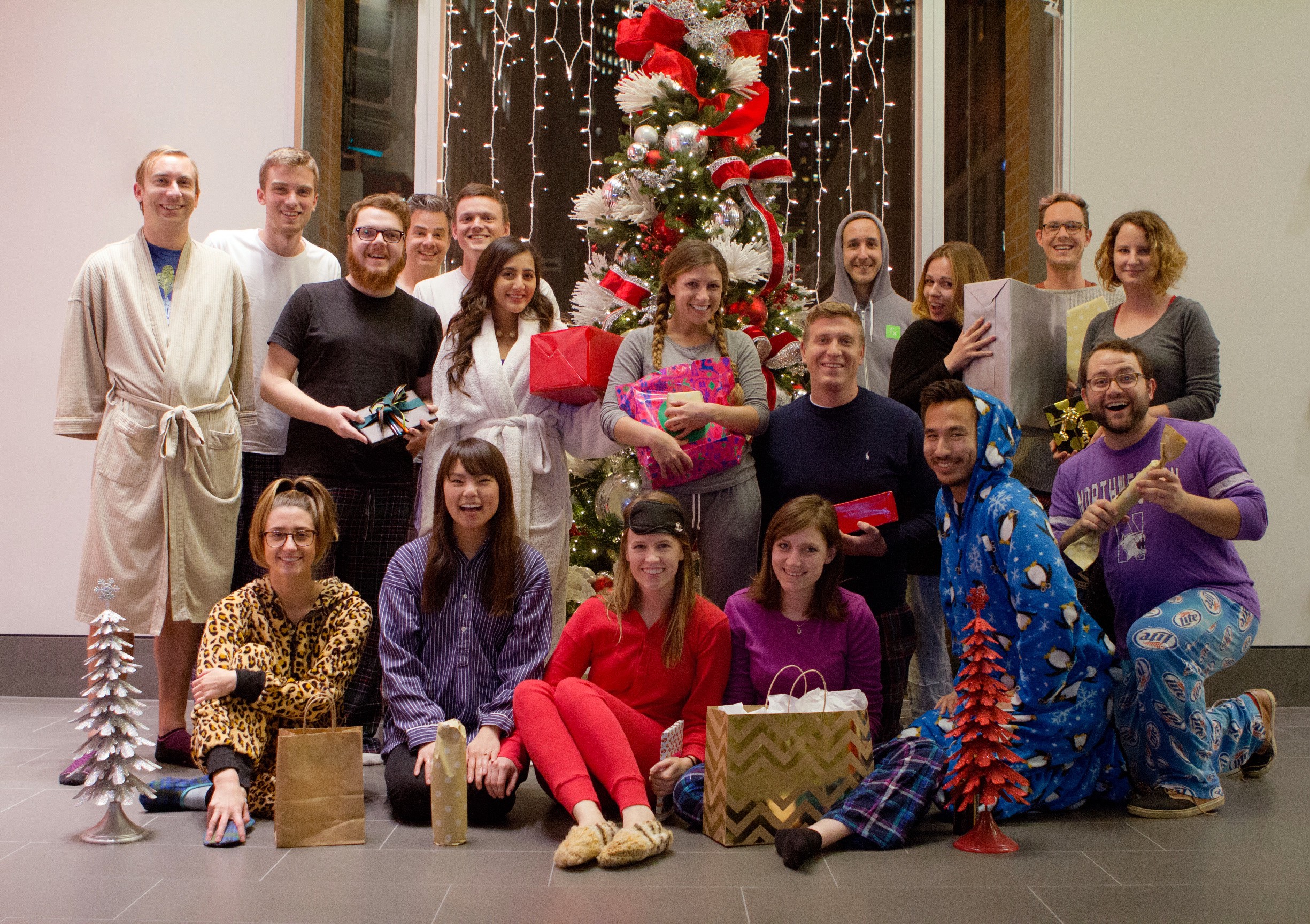
One year, the design team had a Secret Santa gift exchange. We each drew a name out of a hat, got that person a gift, dressed up in pajamas and exchanged our presents in the office. Reliving that now, it was such a goofy thing to do. But we had a ball.
Us dressed in our PJs, exchanging gifts with each other
This was also the era during which we would take a team “holiday photo” and send it to other design teams in the tech community. Why? I dunno, it was just a fun thing to do.
Our team’s holiday photo, right after the PJ gift exchange
So much of what we did in those days feels so random and silly now, but felt completely natural at the time.
The most enduring reason Optimizely will always hold a special place in my heart though, by far, is because I met my wife there. We met at Wine Thursday, which was one of those organic, employee organized cultural staples where people gathered on Thursday evenings to drink wine (which actually started as Wine Wednesday, a much catchier name, but was moved to Thursday once to accommodate someone who had a date that night and then it just stuck on Thursday). We eventually expanded it to include cocktails as well.
It was at one of those that I met my wife, Becca. She had some complaints about — no joke — the documentation of the CSS of our design system, which my team was in charge of. I already had my eye on her, but hadn’t had an opportunity to talk to her (read: I was too shy 😰), so when I heard this I knew I had my in. I chatted her up (yes, about CSS documentation), and we immediately hit it off.
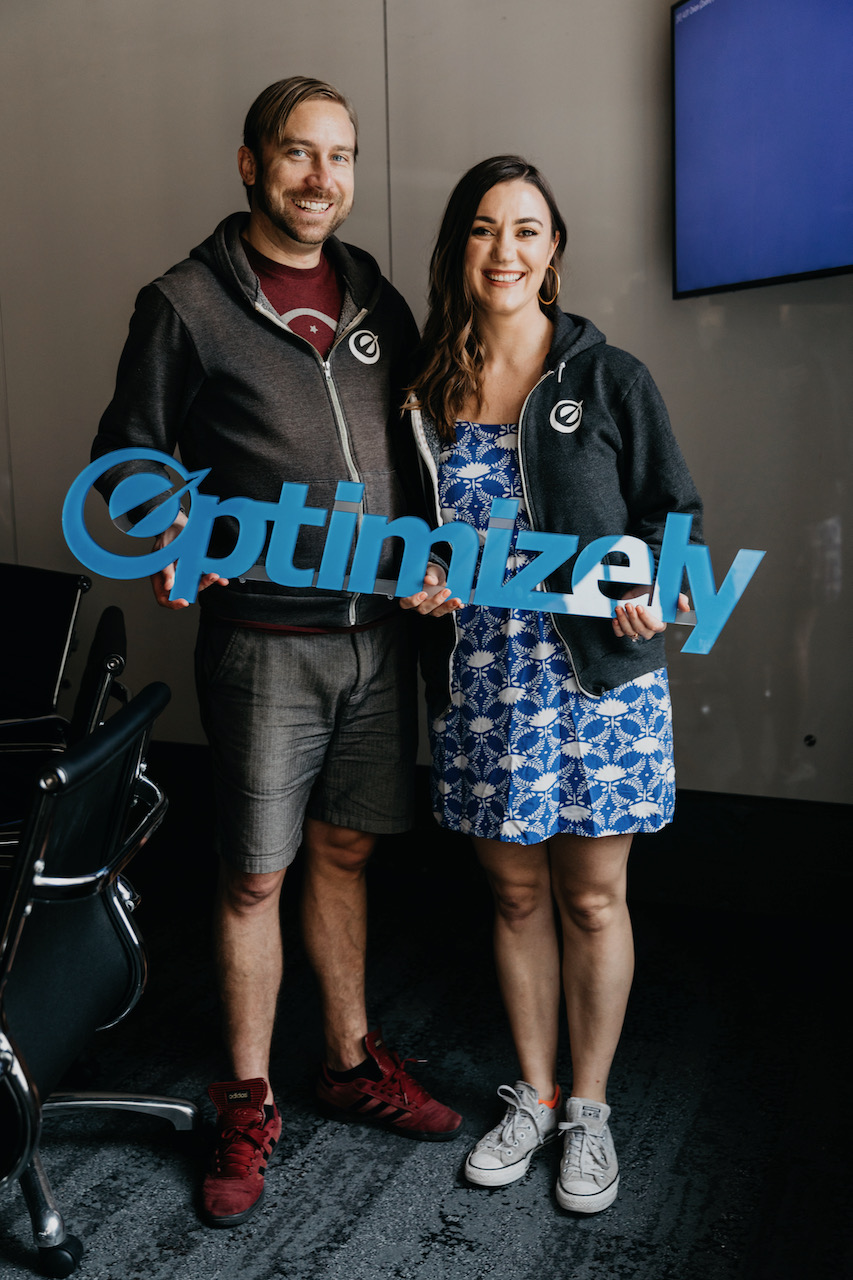
My wife and I, holding a sign of the original Optimizely logo
The next wine Thursday was an “end of the quarter” one (which we somehow convinced leadership to give us money for), so we decided we should dress up and do a wine tasting at CB2 (yes, the furniture store. For some reason they held a joint event with Winc). It was supposed to be a group thing, but only Becca and I dressed up. The fact that I put in that “extra effort” (which was really just wearing a bow tie) won her over 🥰.
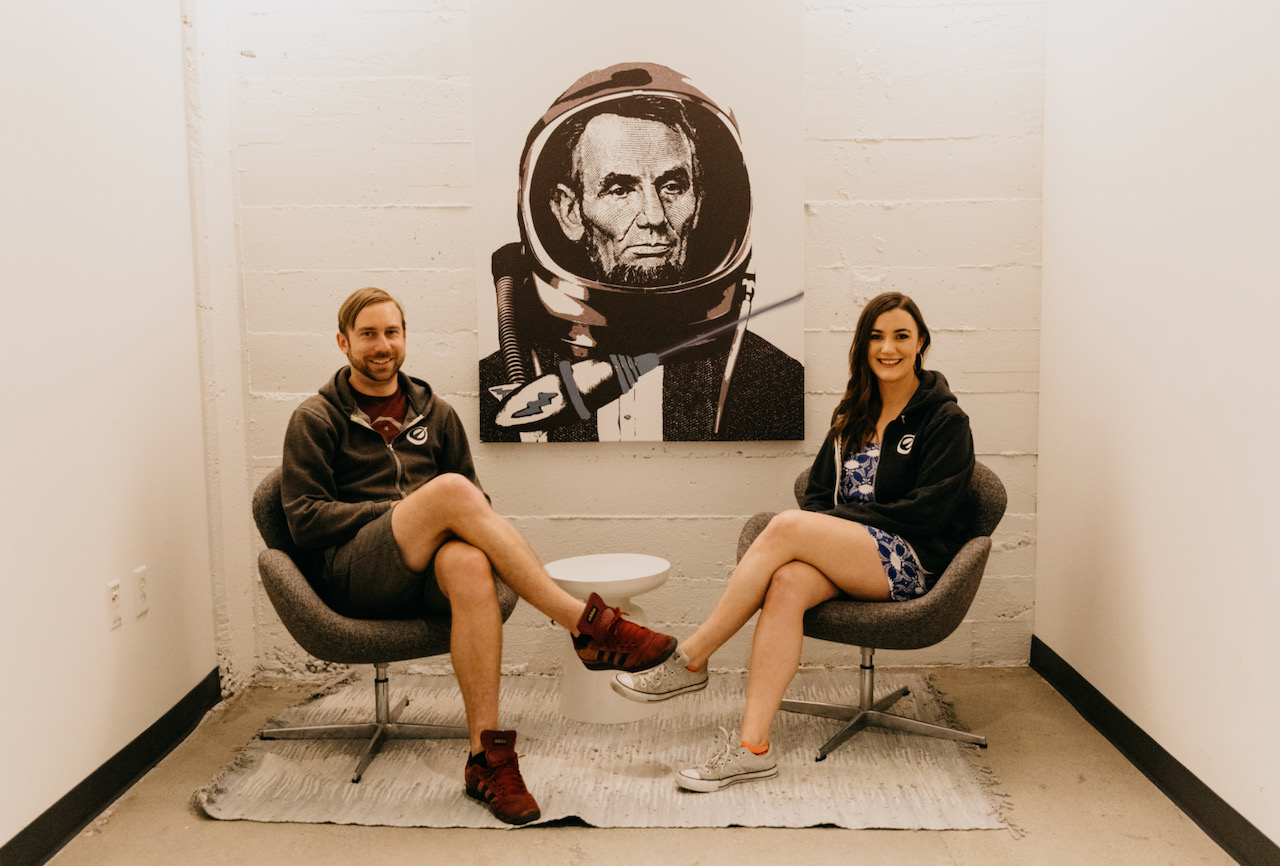
Since this wine tasting was at a CB2, there was a large painting of Abraham Lincoln in a space helmet shooting a lazer gun for sale. Since our company theme was rocketships and space, we thought it would look great in the office. One of our entry-level engineers convinced everyone to chip in 20 bucks to buy it. At the next show-and-tell, he got in front of the whole company and drunkenly told everyone how we bought this as a gift to the company. It remained in the office until they closed it earlier this year.
An engagement photo of us under Opti-Abe
A group of us went to Mikeller’s after that to keep drinking. As the night wore on people slowly peeled off. I was hoping it would winnow down to just me and Becca, but alas one of the engineers wasn’t taking the hint and kept hanging around until eventually all 3 of us left. We started officially dating shortly after this. We consider the Opti-abe night our “zero-eth” date.
Optimizely was my first real tech job, which is why the experience is so special to me. We were tech darlings, on track to be a unicorn, and felt like the world was ours for the taking. I learned and grew more than I ever imagined I would. I was able to move from frontend engineering to product design to management to leading the whole product design team. All of which happened because we needed people in those roles, so when I asked to move into them the response was, “Sure, sounds great!” No other interviewing or trial period or anything. Which is just unthinkable to me now.
The conditions that made Optimizely so special are hard to pinpoint. Most of it is the people, of course. We hired really smart, ambitious people who were early in their careers and eager to prove themselves.
We were also well-funded and had a ton of momentum from positive press and hockey-stick revenue. We didn’t have much oversight and had a lot of space to just try out crazy ideas, fail, and try again.
But it’s more than that. There was an ineffable alchemy that created the conditions for the best place I’ve ever worked.
2020. What a year. What can be said that hasn’t been said a thousand times already? Let’s just skip past that and jump into how it was for me: I was laid off. I considered consulting. I got a new job. Becca got a new job. Optimizely was acquired. We got a new car. A dog. Moved to a larger house. Basically, we transformed our entire life. And thankfully no one close to me passed away from Covid.
A lot happened, good and bad, which pushed me to grow in many ways that I didn’t expect.
Career
The lay-off from Gladly forced me to take a step back and re-assess my career, the path I’m on, and what will keep me satisfied. I started pursuing independent consulting as a way to have a more flexible work-life balance, and make space for multiple simultaneous projects, but I couldn’t get it off the ground.
My hypothesis was that early-stage startups often struggle to attract design talent and successfully integrate them into their development processes. The founders usually aren’t designers, so they don’t know how to run the fledgling design org. They’re too small to have a full-time head of design, and the designers they do attract are usually too junior to know how to set themselves up for success. This felt like a gap I could fill. (It still does).
But what I was trying to do was too ill-defined. Plus I was starting from scratch during a pandemic, when many companies had frozen their budgets, selling to companies that don’t have much money anyway, so there were headwinds against me. And then Becca was feeling less stable at her job, so I went back in-house (ultimately at LaunchDarkly).
Deciding to go back in-house was a bitter pill to swallow, in all honestly. I was hoping to build a more flexible work-life balance where I was more in control of my time. Going back in-house felt like a sacrifice to that vision. (Also, I didn’t want to be new again, since this would be my 3rd job 2 years).
Instead, though, I changed my mindset going into my new role. My job doesn’t have to be my sole creative focus. I can make space for other projects while also having a full time job. The key, for me, is to not expect work to fulfill all of my creative urges, and to reserve energy for projects outside of work. In my previous jobs I would pour all of my energy into them, but that’s not healthy. I need to build time into my life for creative activities that aren’t work related. This mindset shift, and being more attuned to my energy level and not taking on too much at work, has helped a lot.
I still think there’s opportunity to fill the design-leadership gap, so I’m still feeling it out. I learned that it’s better to lay the ground work for future growth and jobs and income streams while you’re doing other things, so I’m doing that now (in addition to side projects, creative hobbies, etc.).
Side projects
Being unemployed — and quarantined — gave me space to re-kindle my love of side projects. I regularly had side projects in my 20s, but then they dropped off when I went to grad school, focused on my career, ramped up my social life, and got married.
I re-discovered that I love having a project to work on slowly, deliberately, over a long period of time. It gives me an outlet to try new ideas on, emerging technologies to experiment with, and learn new skills (or brush up on old ones). Although I regularly try out ideas that inform decisions in my day job, that’s not the primary reason I do them. I primarily do them to scratch creative itches.
In contrast to work, I don’t feel rushed or pressured to get anything done. I don’t have deadlines. There are no stakeholders to please. No internal politics to navigate. I approach them as something fun to work on. I can just follow creative urges as far as they take me, without worrying if it will pan out or not.
There were 2 main projects I worked on:
Center, a personal CRM to help you stay in touch with your network. I’ve been working on it with my buddy Omar, who started it a couple years back. It struck a chord with me since I was managing my network and consulting leads in Notion, which was serviceable but not great. I got sucked in and started helping out on product strategy, design, and frontend coding, which I’m still doing today.
Invisible Ink, which is a writing app that doesn’t show you what you’re typing or let you backspace or edit. You can only write. Why would I build such a monstrosity? The idea came from Vernacular Eloquence, which cited studies showing that people who wrote without seeing their writing ended up with better arguments, and prose that flowed more naturally. Why? Because writing is actually reading and writing, where you write a few lines, re-read it back, edit it, write some more, repeat. This gets in the way of developing your line of reasoning.
Bonus third one: writing on this blog. I wrote 13 posts last year, which is more than the past few years, but not prolific. I like having space to think and write, and am building that into how I spend time outside of work.
Going into my new job with side projects in the hopper has helped me establish a better relationship between my job, creative ambitions, and side projects. I used to want my job to be the be-all-end-all of my creative outlets. But it can’t be. I realize and accept that now. I like writing, hand lettering, programming, graphic design, watercoloring, and more. No job will scratch all of those itches. So I like being in management, and leading teams, so that I can empower people to do their best work in my day job, but save creative energy for my own personal projects outside of work. It feels like a good balance so far.
Creative confidence
By far my biggest growth in 2020 is my newfound creative confidence.
This primarily came from the Artist’s Way, a 12-week program to help you strengthen your artist’s voice. It has helped me be more attuned to what my muse is saying, and given me the confidence to follow it wherever it may lead. This is true both for my personal projects, and my job.
In personal projects, I’m less afraid to follow whatever interesting design idea, lettering idea, writing prompt, etc., that I have. Is it pleasing to me? Do I like it? That’s the main thing that matters. I used to be more concerned with, Is this the right way to do something? Is this how other people would expect me to do it? Instead I am more confident listening to myself. I now use my internal compass as a guide.
This is true in my job, too. I’m more confident pursuing the course of action I see as correct, based on my prior experience and understanding of the field. In the past I’d be more worried about it being the “right” thing, or what my boss expects. Now, not so much. It’s very liberating.
Routine
The routine of quarantine can be dull and repetitive, but there’s aspects of it that work for me. Every morning when I wake up, and I know I’ll be home all day. Home for work. Home for play. Home for side projects and dinner and chores and so on. Home home home. This simplicity means I don’t need to think too hard about what my day looks like. It’s like wearing the same clothes every day — it’s one less thing to think about, so you’re mentally freed up to focus on more important things.
I of course miss seeing people and having in-person events, going to restaurants, seeing live music, and so on. I will welcome those back into my life when they’re ready. But for now, I’m embracing the aspects of routine that work for me.
So ya. 2020, I won’t miss ya. But your hardships pushed me to grow. Now here’s the door.
2020. A year of isolation and social distancing and quarantining. Sounds like it should be a great year for reading, right? Well, not as much as I would have guessed. I read 28 books this year, which is less than last year (only by 2), but still significantly more than the previous 2 years. So not bad, but not as great as I would have expected.
I shifted more of my leisure/quarantine time to side projects and artist dates, which have been very fulfilling, so no regrets there. Also, I read 4 books that were over 1,000 pages, so all in all I consider 2020 a solid year for reading.
A few other things of note:
I read 5 fiction books, which is still low but what can I say, fact is stranger than fiction. And books like Robert Caro’s Lyndon Johnson biography and Matthew Desmond’s Evicted read like fiction, and to me are more compelling because they’re recounting events that actually happened. Even so, the right fiction can be a nice form of escapism, so I do want to dial up the fiction more in the coming year (don’t I say this every year?).
Design, color, typography, and lettering books once again make up a significant portion of my reading list (about a third). I can’t stop, won’t stop reading them. They help me grow professionally and fulfill me creatively.
8 books were written by women, and 5 by people of color (3 being both). This is a fairly low, but not abysmal, percentage overall, so I should try to dial this up in 2021.
I moved my reading list to Notion! Which makes it easier to keep track of counts, dates, authors, filter, sort, etc. Check it out here.
Links below are Amazon Affiliate links, which earn me a small kickback.
Favorite books of the year
Path to Power and Means of Ascent by Robert Caro
I kicked off the year with Path to Power, volume 1 of 5 (potentially more? He’s still writing it) of Robert Caro’s Lyndon B. Johnson biography. I read most of it during our honeymoon, trekking through Patagonia for 5 days with this 1,000+ page beast in my pack (#worthit). I picked up volume 2, Means of Ascent, later in the year, and while slower than volume 1, was still excellent. Caro is by far the best political writer there is. The depth of his research, and the way he makes what should be dry political maneuverings into Shakespearian drama is incredible. It inspires me to be better in my craft.
Beyond just being well-written, the content resonated in these polarizing political times because a large chunk of Means of Ascent is about how Lyndon stole the 1948 senatorial race by buying votes from counties and unregistered voters, and cemented his win with legal maneuvering. Sound familiar? Knowing all this transpired previously made me very concerned that it could happen again this year. Thankfully it didn’t, and fraudulent votes didn’t seem to be an issue, but even so it’s wild to read about how he stole a senatorial election, concealed it, and went on to become president.
The Artist’s Way by Julia Cameron
I wrote a whole post about this book, so I don’t have much to add and you should just go read that instead. I will say, though, that I continue to use the techniques in this book and have made morning pages (and to a lesser extent, artist dates) a part of my regular routine. I can’t recommend this book highly enough to anyone who wants to tap into their true creative potential (hence the star rating 🌟).
Vernacular Eloquence by Peter Elbow
Another book that I wrote an entire post on, so just go read that. Definitely the most impactful book I’ve read in terms of making me a better writer. It also highlights lots of failures in our school system, racial and systemic biases perpetuated through education and reading and writing. Reading this during the George Floyd protests made those sections especially impactful. I’m still thinking about that stuff today.
Interactions of Color by Josef Albers
The third book that I wrote an entire post on. This book took me about 5 years to get through, with many fits and starts in between. I’m really glad I read the book and, more crucially, did all the exercises. Reading it without doing the exercises is a waste of time. The whole point of this book is the exercises. It completely changed the way I look at color, and has made me much more attuned to the characteristics of colors and, more importantly, the interactions between colors. Wholly recommended if you want to be a better designer or artist.
Colorless Tsukuru Tazaki and his Years of Pilgrimage by Haruki Murakami
I picked this book up on whim when I saw it in the recommended section at Green Apple Books. I had somehow never heard of it before, despite being a Murakami fan, and ended up thoroughly enjoying it. It resonated during the pandemic since it’s about isolation and loss and discovering who you are.
Full reading list
Also in Notion, which I keep up-to-date with what I’m currently reading, and includes previous lists.
Colorless Tsukuru Tagalog and His Years of Pilgrimage by Haruki Murakami (Dec 9, 2020) Recommended? 👍
The 99% Invisible City by Roman Mars and Kirk Kohlstedt (Dec 26, 2020) 👍
11/21/63 by Stephen King (Nov 9, 2020)
Bluest Eyes by Toni Morrison (Sep 21, 2020)
Someone who will love you in all your damaged glory by Raphael Bob-Waksberg (Sep 10, 2020) 👍
The Color of Law by Richard Rothstein (Aug 31, 2020) 👍
The Designer’s Dictionary of Color by Sean Adams (Aug 1, 2020) 👍
Means of Ascent by Robert Caro (Aug 26, 2020) 👍👍
The Multi-hyphenate Life by Emma Gannon (Jul 16, 2020)
How to be an Antiracist by Ibram X. Kendi (Jul 13, 2020) 🙌
My Year I’d Rest and Relaxation by Otessa Moshfegh (Jun 25, 2020) 👍
Why Have Kids by Jessica Valenti (Jun 7, 2020)
The Artist’s Way: A Spiritual Path to Higher Creativity by Julia Cameron (Aug 28, 2020) 🌟
Vernacular Eloquence: What Speech Can Bring to Writing by Peter Elbow (Sep 7, 2020) 👍👍
How to do Nothing by Jenny Odell (May 26, 2020) 👍
Range: Why Generalists Triumph in a Specialized World by David Epstein (May 13, 2020)
Vintage Hand Lettering by Lisa Quine (Apr 26, 2020) 👍
Leonardo da Vinci by Walter Isaacson (Apr 24, 2020)
Emotional Design by Aaron Walter (Apr 12, 2020) 👍
The Stroke: Theory of Writing by Gerri Noordzij (Apr 5, 2020) 👍
Interactions of Color by Josef Albers (Mar 21, 2020) 🙌 (started sometime in 2015)
Design as Art by Bruno Munari (Mar 16, 2020)
Creative Spaces by Ted Vadakan and Angie Myung (Mar 16, 2020)
Evicted by Matthew Desmond (Mar 8, 2020)
Wabi Sabi by Leonard Koren (Feb 15, 2020)
Path to Power by Robert Caro (Feb 12, 2020) 👍👍
Writing is Designing by Michael J. Metts and Andy Welfle (Feb 6, 2020) 👍
Moonwalking with Einstein by Josh Foer (Jan 19, 2020)
I recently noticed that my team of Product Designers at LaunchDarkly (p.s. I’m hiring) was having trouble navigating the overlap of Product Design and Product Management. No one said it explicitly, but after hearing some frustrations in 1:1s and team meetings I connected the dots that this issue was the common variable across a variety of complaints.
I was hearing things like, “I’m supposed to own the user experience, but the PM keeps cutting scope from my designs!” And, “Am I expected to run team whiteboarding sessions?” There was also confusion around the fact that sometimes they do customer interviews, and other times PMs do.
Product Managers also had some struggles with navigating this gray area. They want to shape the final product (as they should), but were unsure how best to provide input without stepping on the toes of designers. If I sketch out my ideas, am I doing the designer’s job for them? Is it ok to ask designers to do customer outreach and development? If the designs I’m seeing are missing the mark, how do I give that feedback without telling them their work stinks?
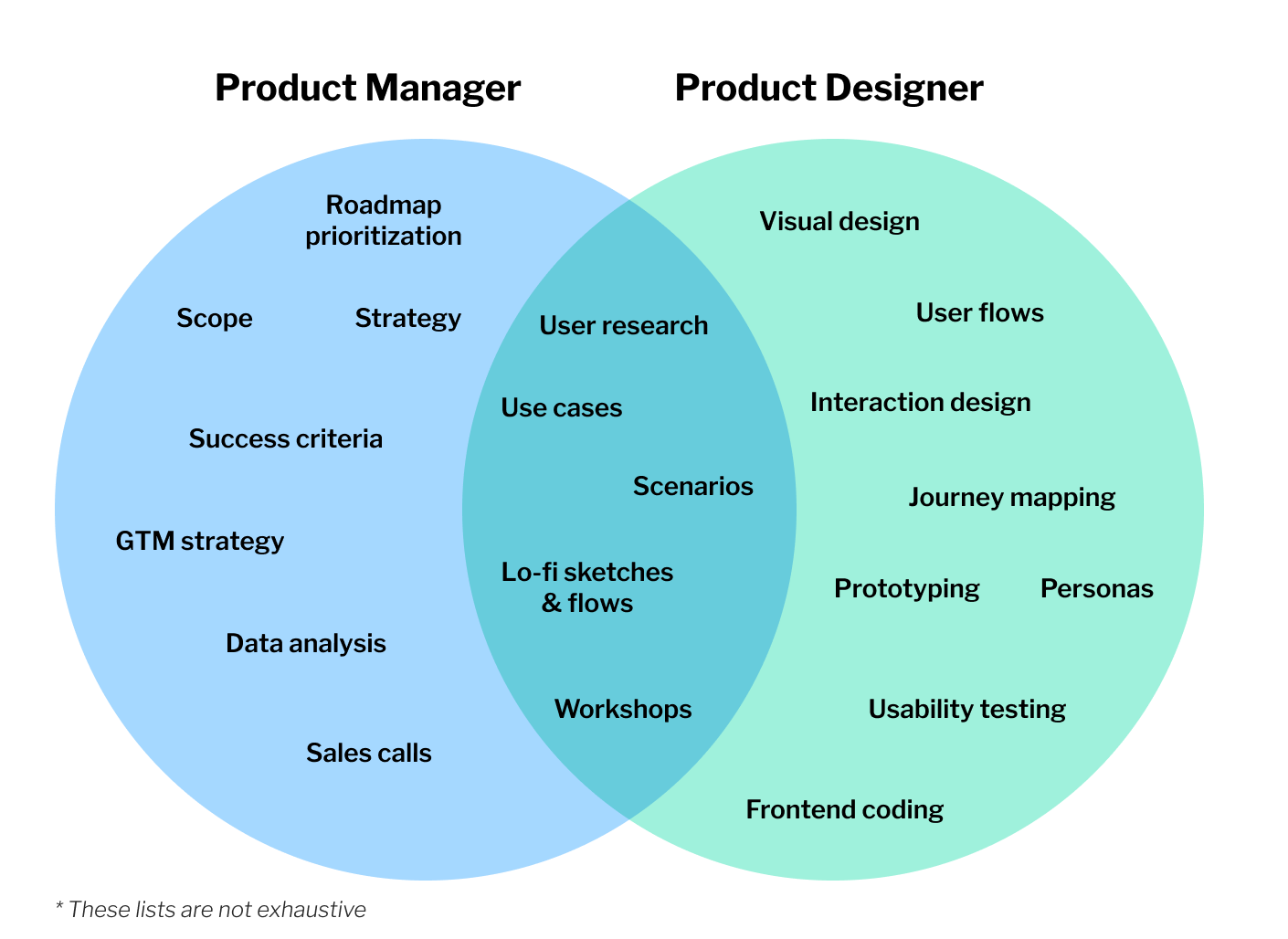
To clarify expectations for both sides, I wrote the doc below. It doesn’t try to draw a distinct line between the two roles, but instead explicitly states the area of overlap and provides guidance on how to navigate it. I also give advice for leaning on each other, such as asking PMs for scope, or asking designers for more iterations.
So far this doc has alleviated some confusion on both sides, and empowered my team to speak up when they need more from their peers.
If you or your team is struggling with this as well, I hope this doc will help.
The roles of Product Designer and Product Manager have a significant amount of overlap (they both have “product” in their title, after all). So who does what? Having overlap and redundancy is healthy and makes sure multiple people are thinking about the big picture. But fuzzy roles and unclear decision makers leads to people spinning their wheels and unproductive power struggles. This doc aims to clarify who does what by explicitly laying out roles, the overlap, and how to navigate the ambiguity.
Product Designers
Product Designers are responsible for creating great user experiences. What does that mean, though? Don’t we all own the user experience? In a sense, yes – everything the triad does will impact the final experience. Sales, support, and marketing all impact the customer’s experience, too. But in the context of the triad, the designer should be pushing for the best experience that meets business and customer goals, with the project constraints (scope, technical tradeoffs, what’s available in the design system, and so on). If the proposed design doesn’t meet the customer’s needs, or is hard to use, or unpolished, or doesn’t follow our patterns, that’s on the designer. They do this by owning:
Final visual design
Interaction design
Prototyping
Usability testing
Personas
Journey mapping
And more, this list isn’t exhaustive
Product Managers
Product Managers are accountable for the business value of their team’s output. If a project isn’t valuable to customers or LaunchDarkly, has unclear or incorrect scope, fuzzy use cases, takes too long to build relative to the value, or the team doesn’t understand what problem they’re solving or why, that’s on the PM. They do this by owning:
Roadmap prioritization
Team goals & strategy
Project scope
Project goals and success criteria
Data analysis
And more, this list isn’t exhaustive
The overlap
This still leaves a healthy amount of overlap between the two roles. Both do:
User research
User scenarios
Use cases
Lo-fi sketching and flows
Team workshops & whiteboarding
And even more, this list isn’t exhaustive, either
So who owns these activities? The answer is both. The best projects will have designers and PMs collaborating on these. But sometimes a designer takes the lead on research, or the PM will lead whiteboarding activities. It will depend on who has the time, skills, and interest, among other factors. When things are unclear, they should discuss who is doing what.
Additionally, being accountable for an outcome doesn’t mean you’re on the hook for doing all the work to achieve it. Nor does it mean you can’t contribute to what someone else is accountable for. Designers should contribute to use cases and scope. Engineers and PMs should contribute design ideas. Everyone should contribute to the roadmap. But at the end of the day, the person accountable for the final result has final decision making power.
Even so, this won’t prevent disagreements. You may not agree with the final scope, technical architecture, or user flows. Voice your concerns, have a healthy (but respectful) debate about the tradeoffs, and try to reach consensus or a set of next steps to resolve the tension. But at the end of the day, recognize who is accountable for the outcome, and thus the final decision maker, and disagree and commit.
Lean on each other
Knowing who’s accountable for what gives you someone to lean on when things are ambiguous. Use this to your advantage.
For Product Designers
Lean on your PM if you don’t understand the project’s goals, use cases, scope, or value. You can and should have an opinion on these, and shape them with your work, but it’s a fool’s errand to try to finalize a design if these aren’t crisp.
If you’re not sure about the technical tradeoffs of your design decisions, lean on your engineering counterpart.
If the PM or engineers have an idea for a solution, listen to it and make it real, even if you’re not sure it will work. Design’s super power is giving form to abstract ideas. Discussing a cheap throwaway mockup you’ve made can shortcut weeks of debate. I wrote a longer article about this.
You are expected to push for shipping the best user experience you can. Sometimes this increases the scope of a project. Sometimes this increases the technical complexity. You should discuss tradeoffs with your triad and reach consensus together. Don’t assume what’s easy or hard. Then make the best damn designs you can within the scope and constraints agreed upon.
Scope, use cases, and goals can and will change as projects move through discovery. Seeing real designs and getting user feedback changes your understanding of the opportunity space, so you should update the product spec accordingly.
For Product Managers
Lean on designers to help you with scope and use case decisions by cheaply exploring ideas together.
If you have an idea for a solution, get it out of your head and share it with your designer. But acknowledge it’s just an idea and the designer owns the final designs.
You see an area of opportunity that needs more research but don’t have time, ask your designer if they can lead customer calls.
If the solutions the designer is proposing are missing the mark, ask them to explore more ideas. Or whiteboard together if you’re seeing paths the designer’s not going down. You don’t need to be an expert in design and pinpoint exactly what isn’t working, but you can always ask for more options.
Create greatness together
Tension and overlap is healthy when roles and expectations are clear. This doc is a starting point and guide, but it takes practice to successfully navigate points of conflict. But when done right, you’ll ship solutions better than you would have alone.
Sound like the type of team you want to work on? I’m hiring.
 Drunken photo of us in Santa Cruz
 My wife and I in front of the new Optimizely office (this is from our engagement shoot)
 Countdown to the first Opticon
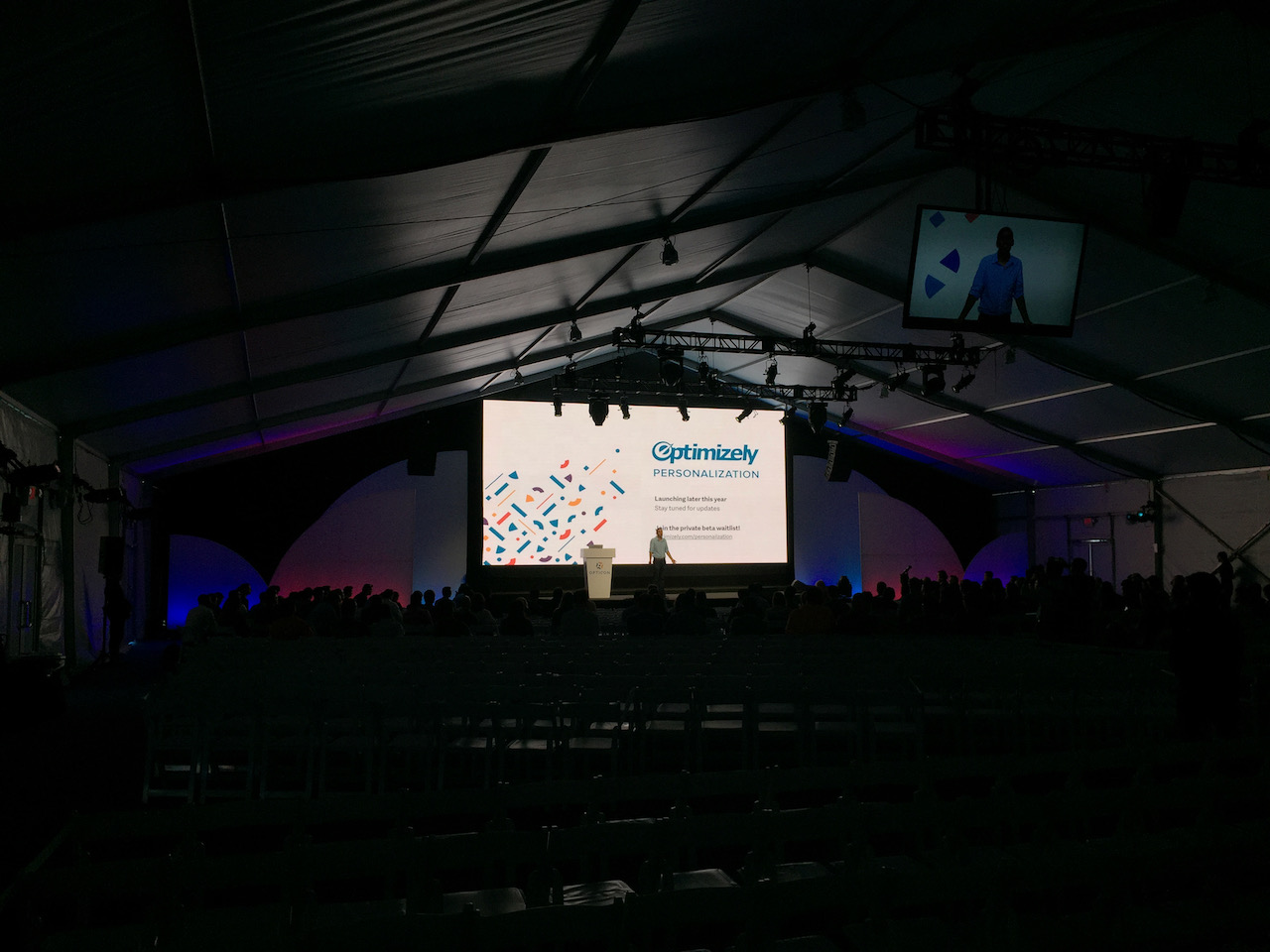 Opticon’s main stage, where we announced Personalization
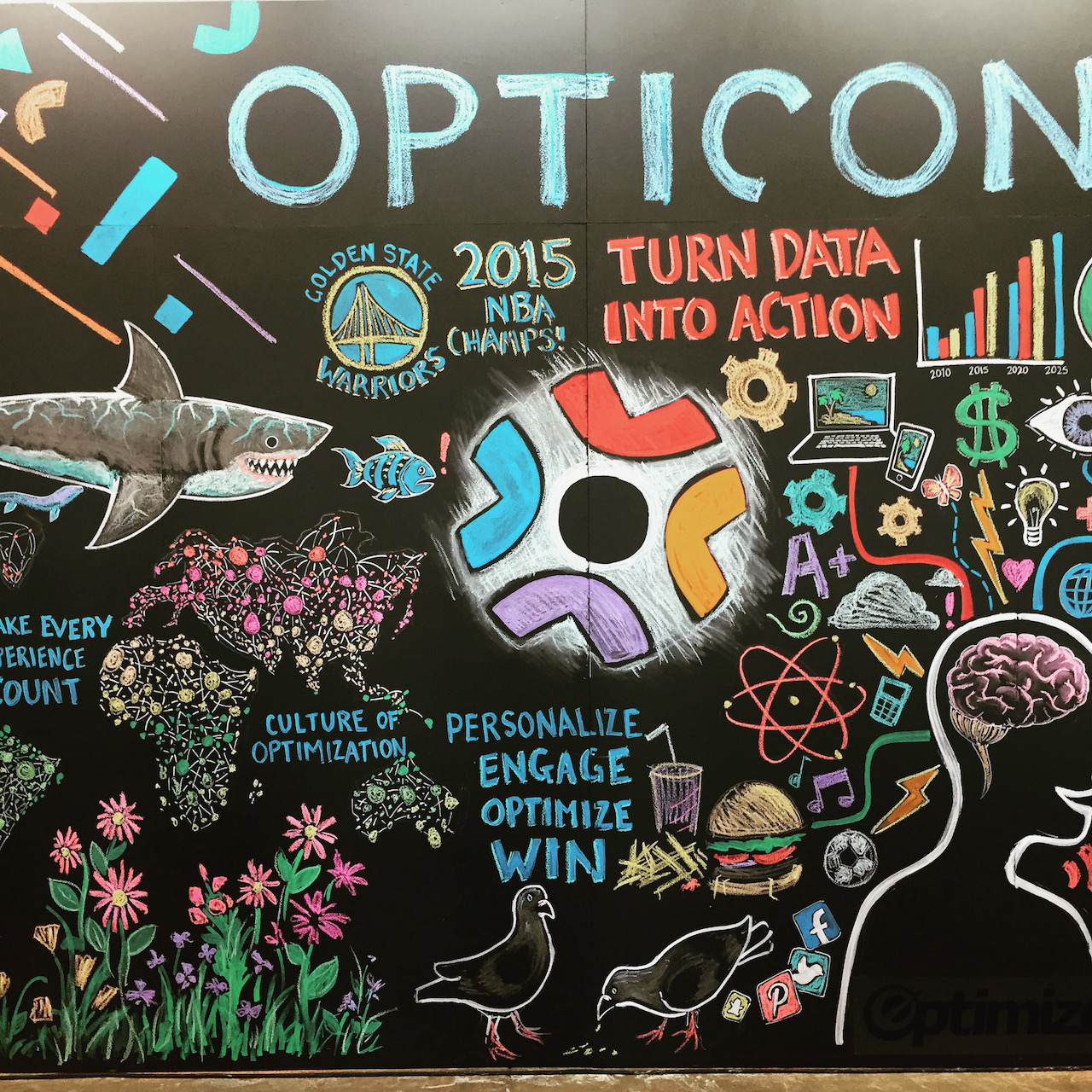 Some sweet chalk art that greeted attendees
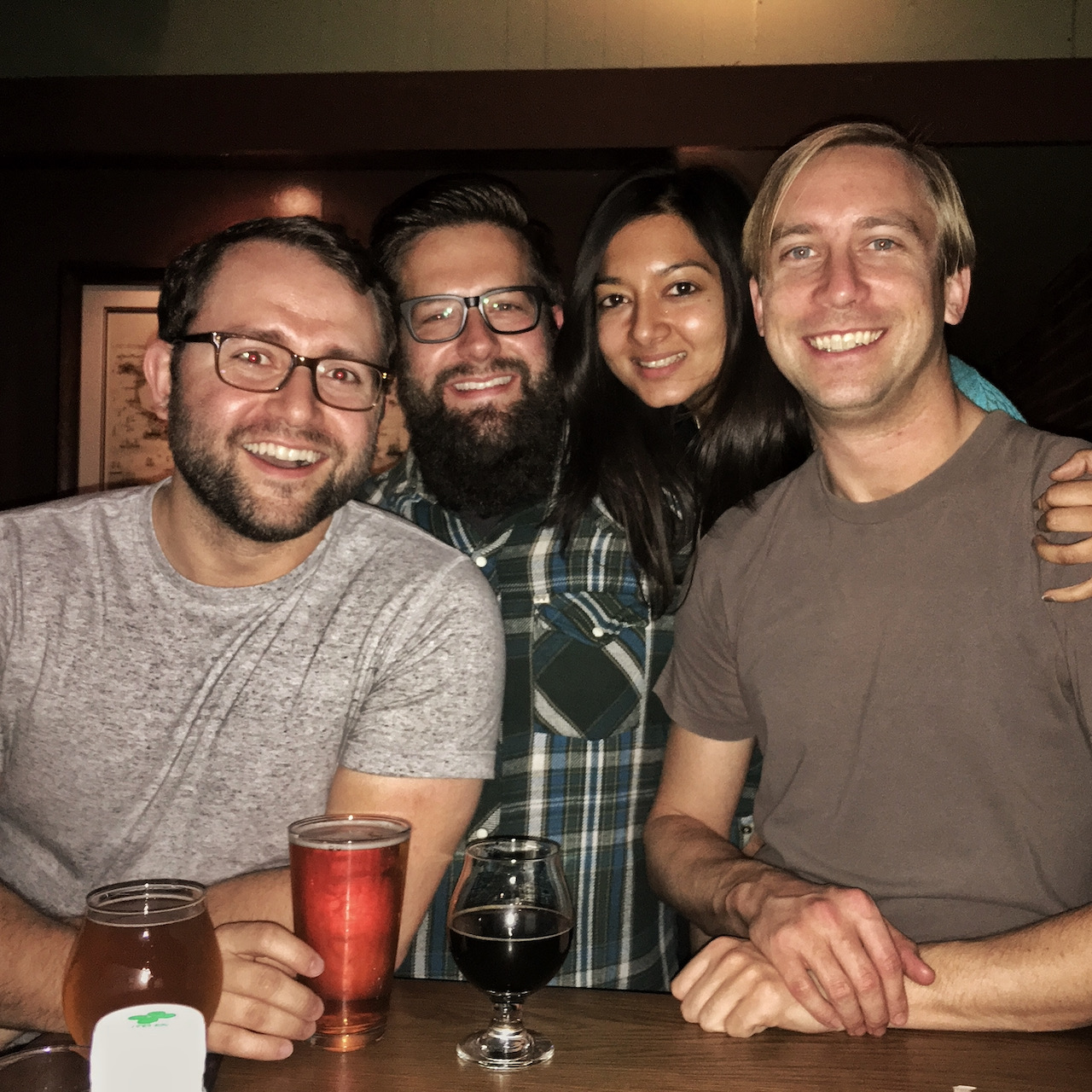 The original D-team 4
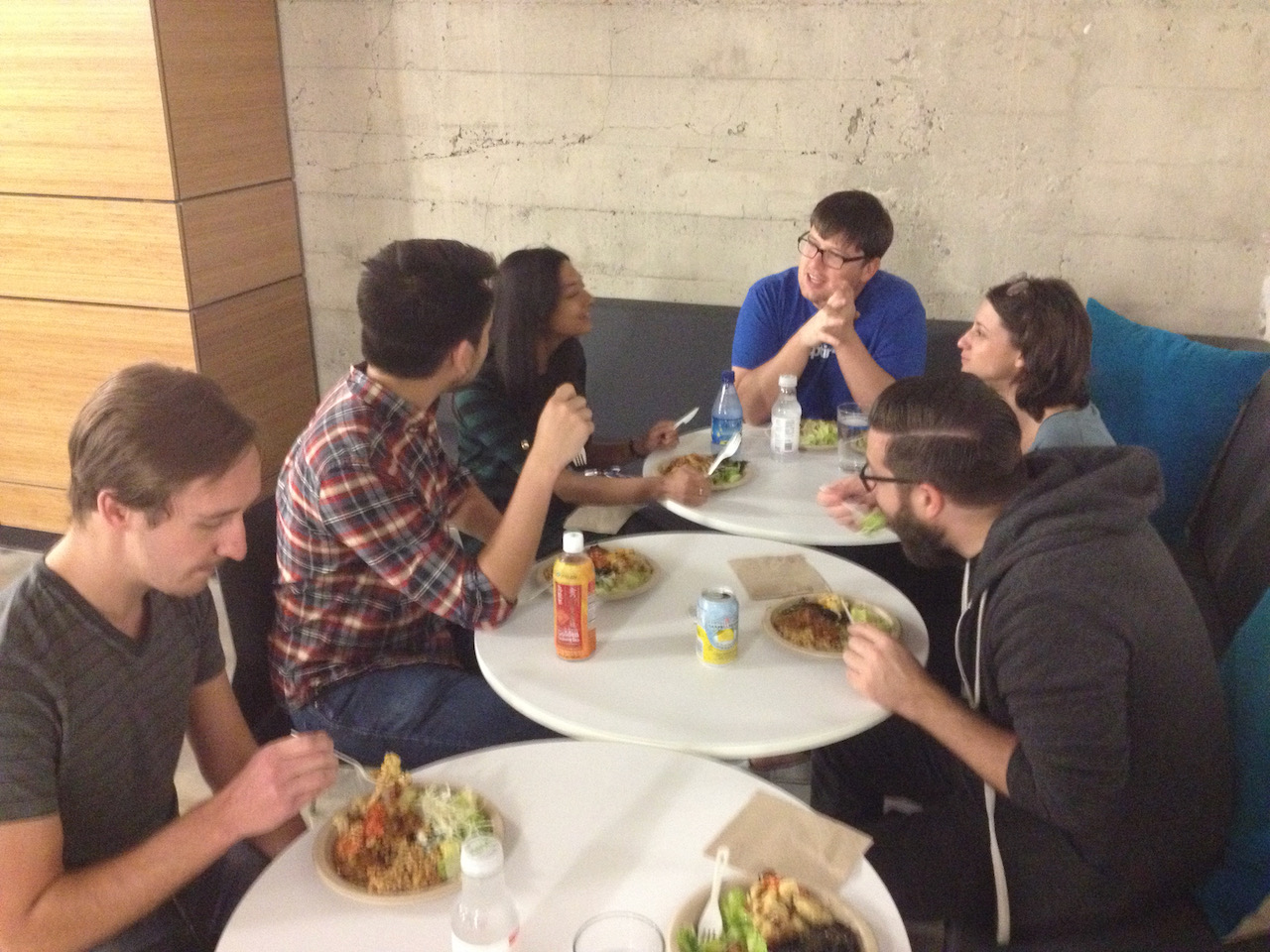 Early design team lunch
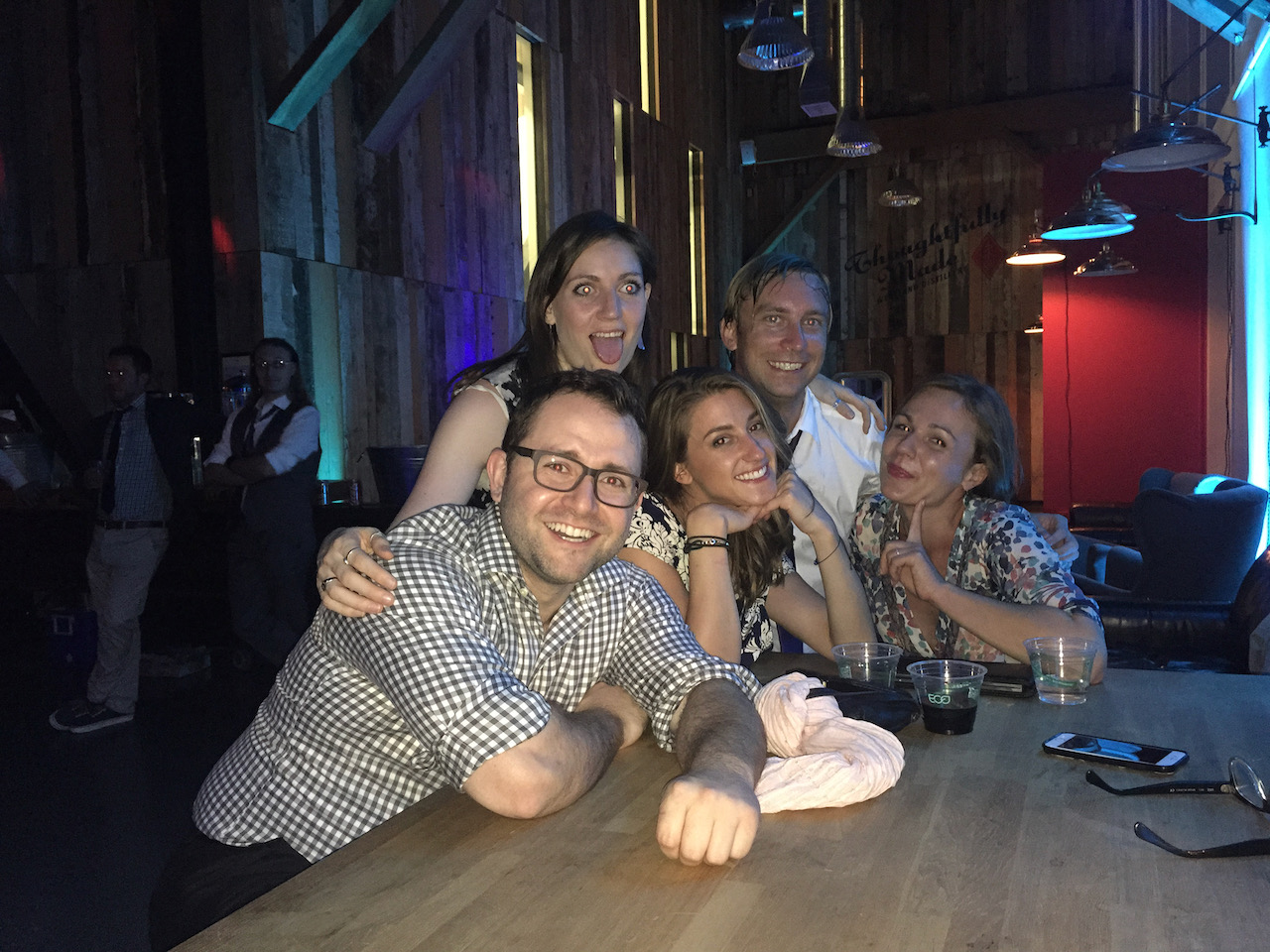 Some of us at another designer’s wedding
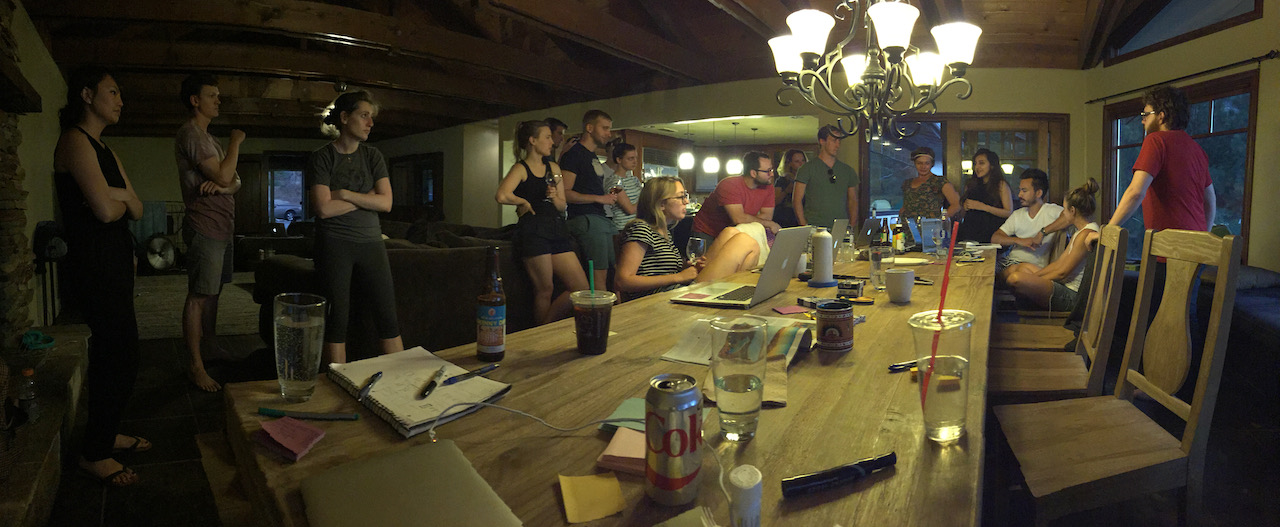 The team gathered around the table at our cabin in Tahoe
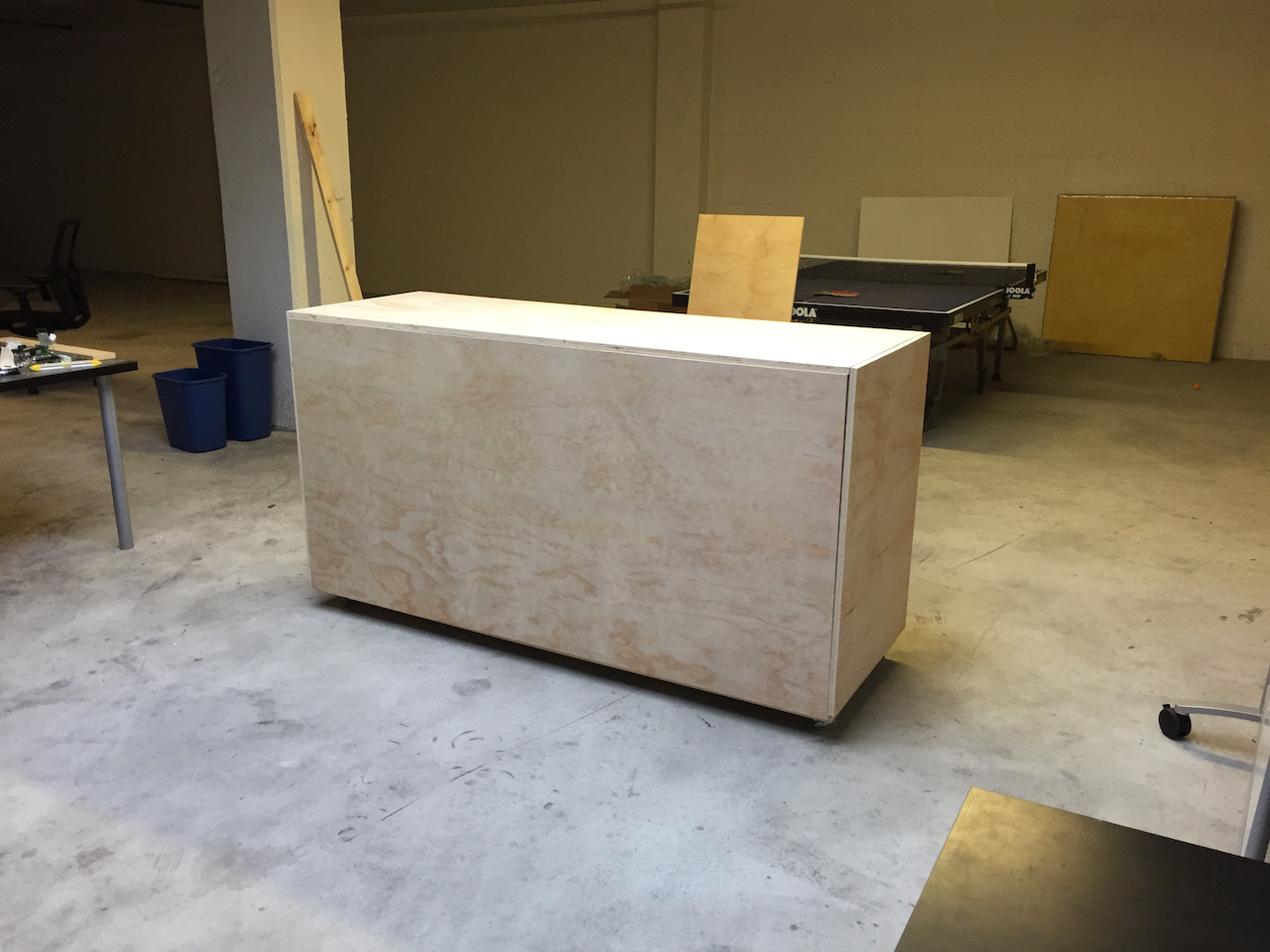 Our finished UX bar, built in this weird dead space in the office that was going to be built out as a kitchen but ended up never being used for anything
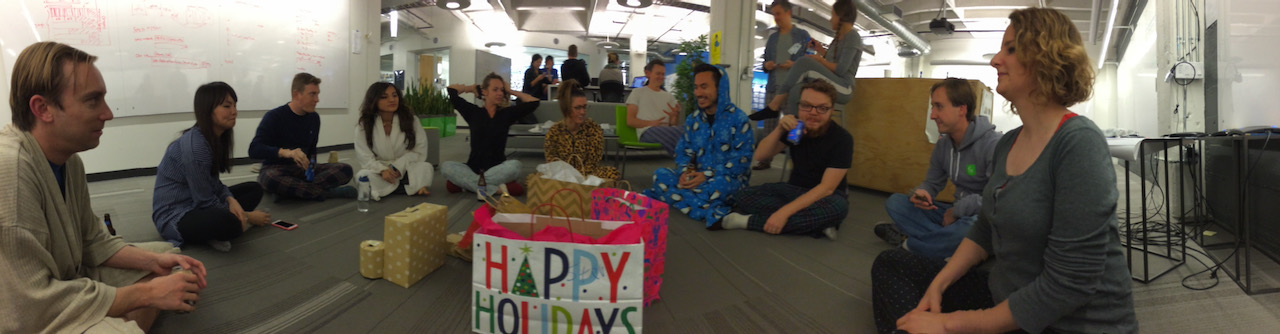 Us dressed in our PJs, exchanging gifts with each other
 Our team’s holiday photo, right after the PJ gift exchange
 My wife and I, holding a sign of the original Optimizely logo
 An engagement photo of us under Opti-Abe