My friend Titus reached out a while back to do some brand work for his new venture, Square in a Circle. He’s branching out into life coaching and voiceovers, and needed an identity that could hold all of that together.
Right away he had a strong reference point: the lyric “Square in a Circle” from the Seal song Whirlpool. The line resonated with him because it captures this feeling of trying to fit into a shape that was never meant for you — a square peg in a round hole.
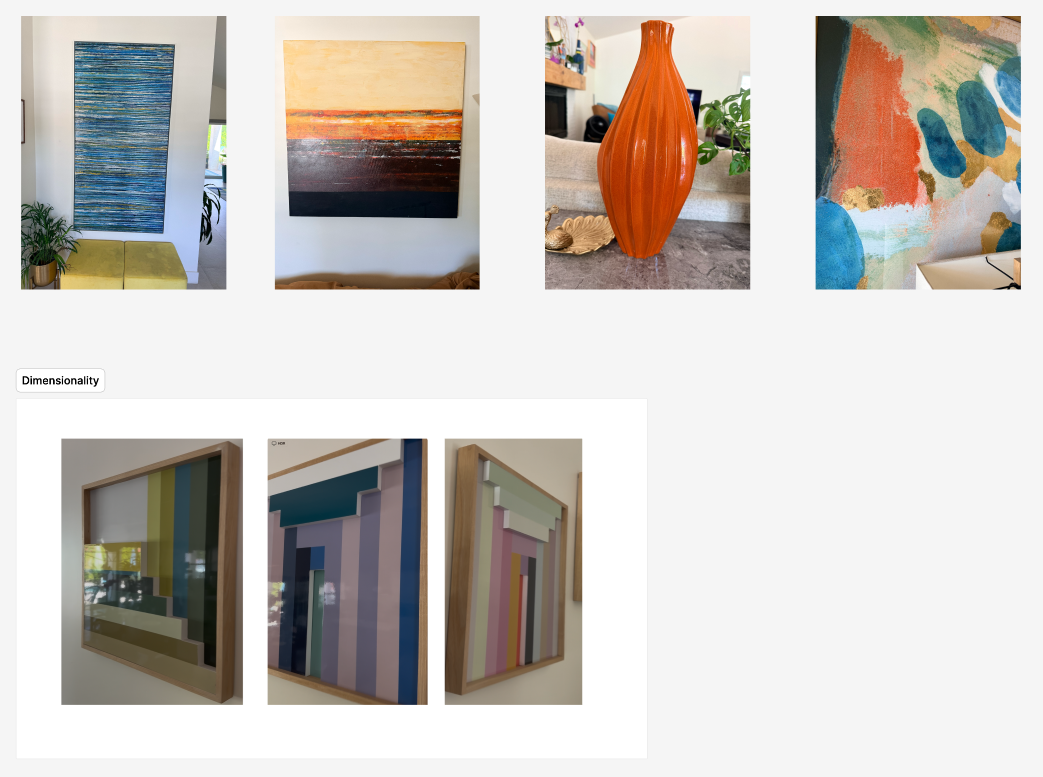
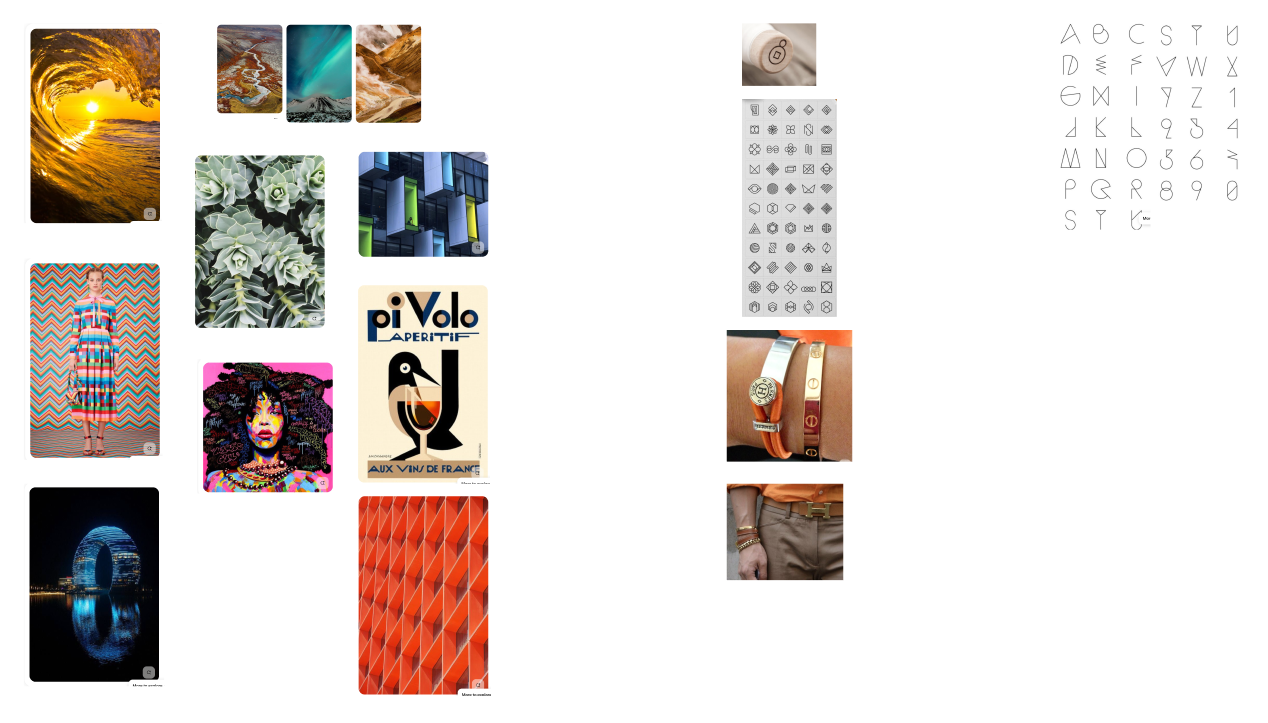
To give me more context, Titus sent over photos of stuff around his house — burnt oranges, teals, metallic finishes, some real depth and richness to the palette. He also sent Pinterest boards of buildings, icons, imagery he was drawn to.
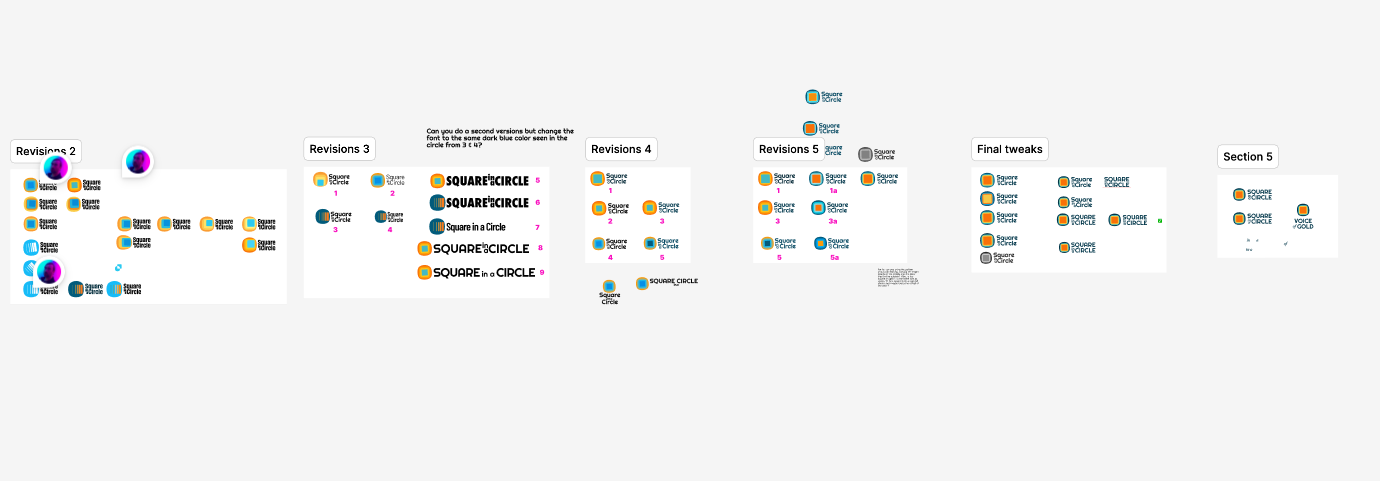
Samples of our mood board
Finding the concept
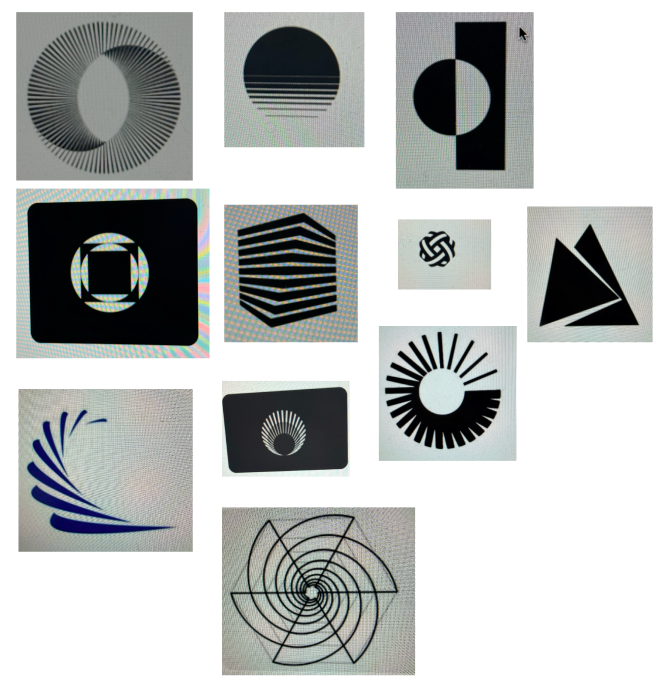
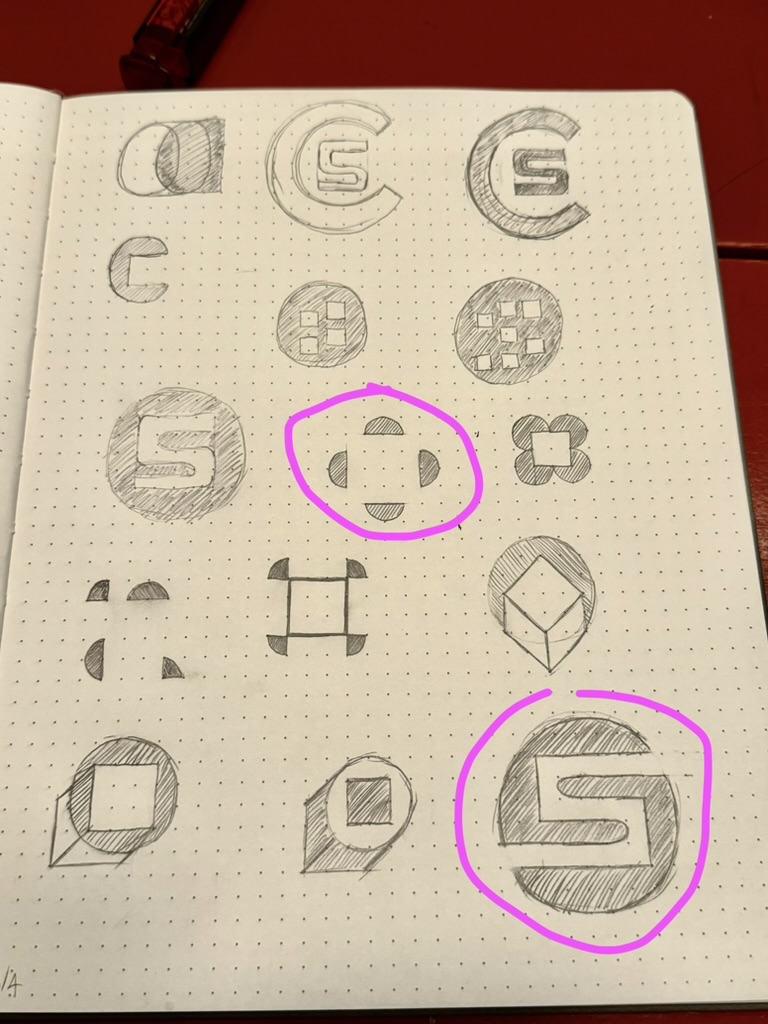
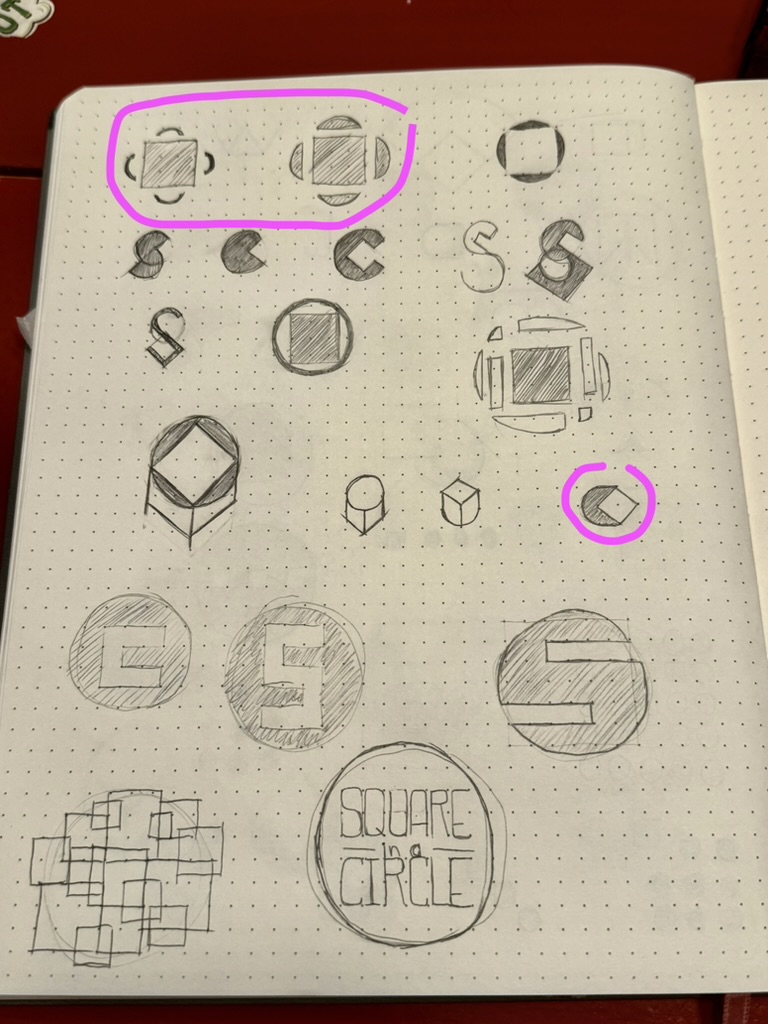
Early explorations were pretty literal: various combinations of squares and circles, shapes breaking out of other shapes. There were some cool icons in there, in a purely geometric sense. But there was no why to them. Visually clever, but no meaning behind any of it. It lacked soul.
Some sketches of various concepts
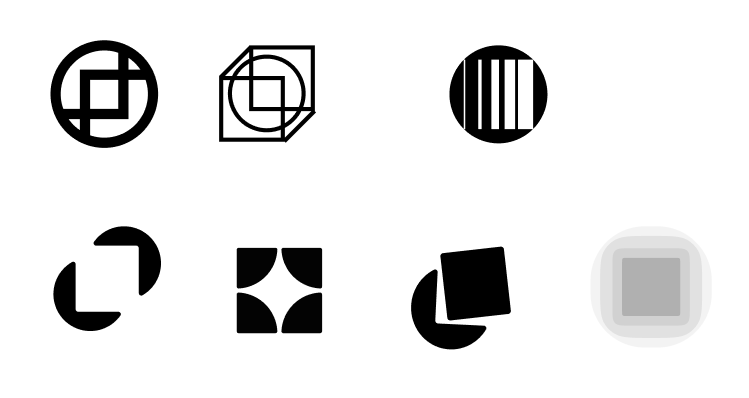
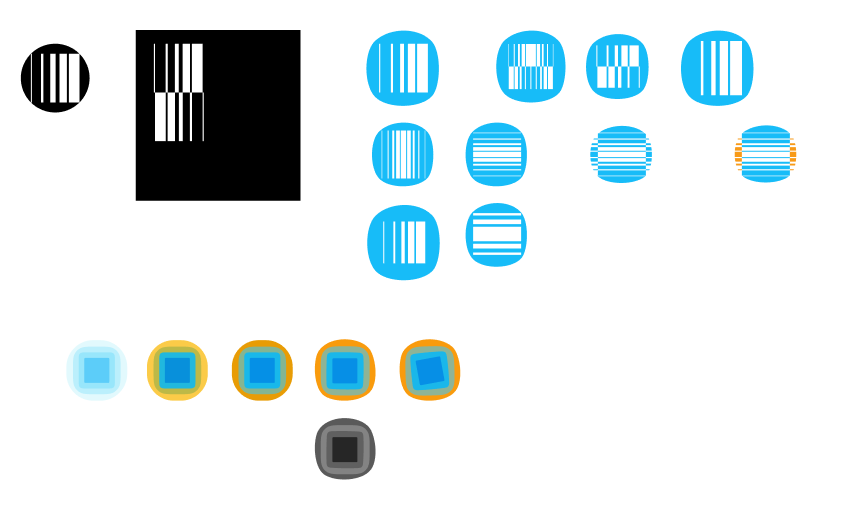
Playing around with vectors
But then something interesting started emerging: the idea of transformation and growth. Not just a square inside a circle, but a square that has moved beyond fitting in, transcended that constraint. That’s found itself. That felt true to what Titus is doing with his coaching work — helping people grow into who they’re supposed to be — and true to Titus personally.
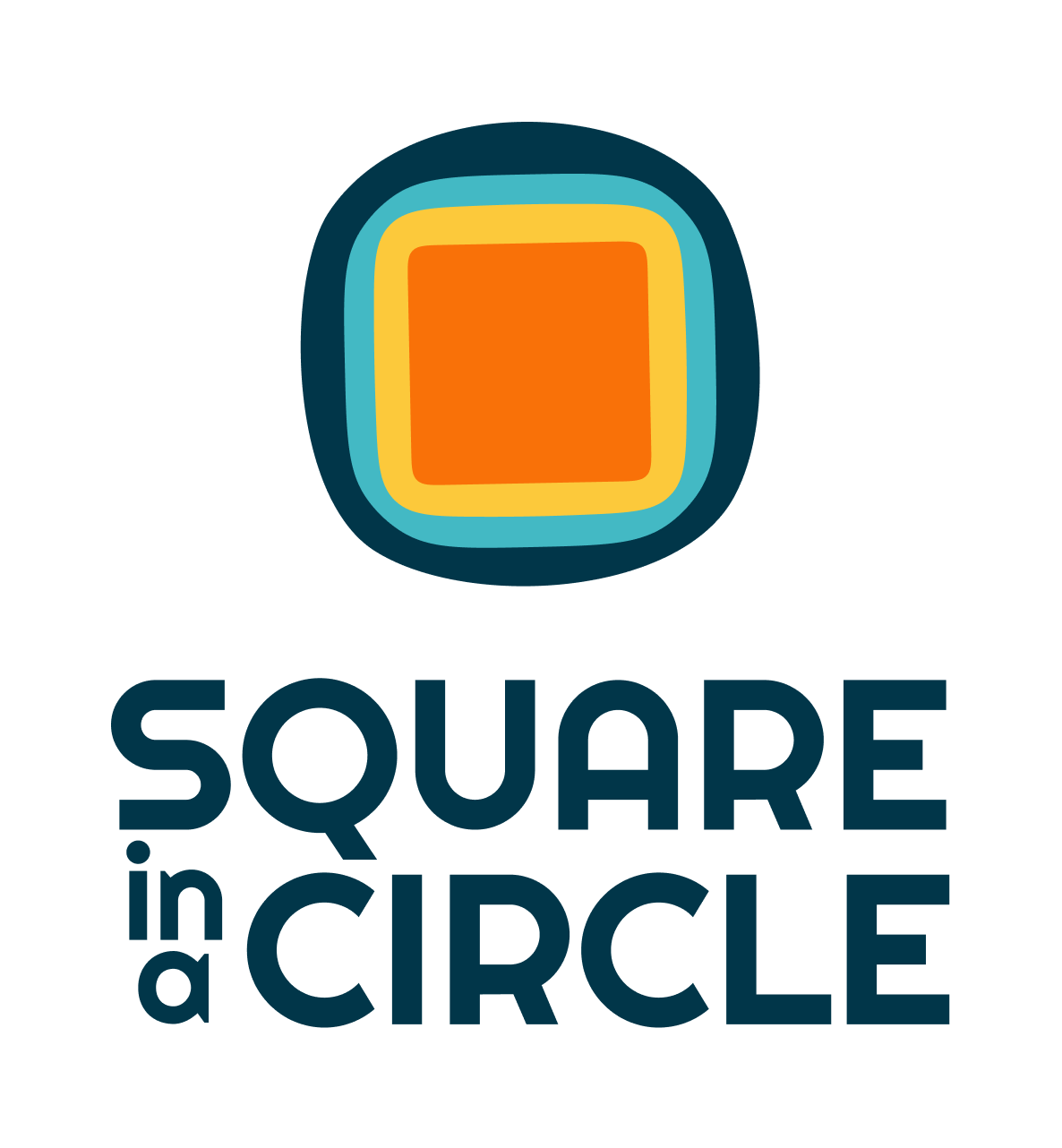
Where we landed
We played with a lot of color treatments and mark directions and typefaces before it clicked. We landed on a final mark of concentric layers of a circle transforming into a square. Each layer has a bit of imperfection to keep it human. And because growth isn’t linear.
The square is the core, the bright center that holds everything together. Everything radiates outward from it. It’s not about fitting in or breaking free, it’s about the square finding itself, being exactly where it’s supposed to be, and everything else building out from that. That feels right for a coaching brand about becoming who you’re meant to be.
Titus loved it immediately. He felt like it represented him and what he was going for. And everyone he’s shown it to has agreed that it feels like him. Which is the exact reaction I was hoping to hear.
p.s. Titus is an amazing life coach (and human!) so check out his website at https://www.squareinacircle.net/. Not only that, but he has a voice of gold, too, and does voiceovers.
The idea of AI replacing product designers isn’t scaring me. It’s actually having the opposite effect: I’m embracing it.
Take my job AI! I’m done with it!
What follows is a mix of thoughts of where I’m at personally in my career, and observations on industry trends.
On the personal side, I’ve become more and more disillusioned with product design. It can be a shit role where you’re stuck between product managers on one side, engineers on the other, “the business” above you, and your actual users below you. What remains is an increasingly cramped space for decisions we actually “own”, which is basically which color lip stick to put on the pig.
The overall UX is dictated far more by decisions made upstream of you (by product and business value), and decisions that come after you (what can actually be built? In what time frame? How much do the engineers care about going beyond the bare minimum of getting something working?).
When the UX comes out sub-par the designer or design team are to blame.
Design as a profession is regularly devalued. Our viewpoint and input ignored. We’re the middle children of product development: PMs are the eldest children who call the shots, engineers are the youngest child who can hide behind the code, and design is caught in the middle with no real power while trying to play peacemaker between the other two.
So I’m at a point in my career where I’m ready for a change. I want my career to change. But there’s nothing obvious to change to. Neither product management (which many designers switch into as a way of getting around the problems above) nor engineering (which I’ve done previously) are appealing.
I don’t see “design” as a profession as it’s currently defined changing. The structural problems are too entrenched.
I’m also ready to evolve beyond a “product designer”. I’ve never liked titles or being boxed in by roles dictating what you can and can’t do. I want a new world where I can embrace more of my skills and be a multi-hyphenate and stretch my wings creatively.
And at the end of the day I love building products. Problem solving. Making creative decisions. Understanding people. Coding. I love the web. So I don’t really want to leave the industry or stop the actual work I enjoy doing.
And this is why I’ve come to see AI as a potential savior. Something that will break down how we build product into its constituent parts so we can build it back up again. Better.
What will that look like? What will the new roles be? Why do we even need engineers or PMs or designers when AI can spit out everything those roles create faster and cheaper and (in many cases, and increasingly often) better?
We don’t.
And yet we’re still going to need people guiding the AI and making decisions with it.
I don’t know what that will look like. But I’m excited for a change. And if I’m lucky I’ll get to have a hand in shaping what that future is.
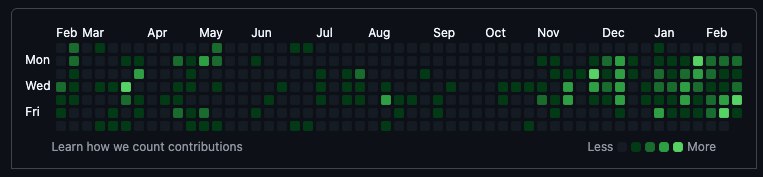
This image tells the story: the uptick in commits is me designing and shipping with Claude Code. I’m using it daily. Likewise, my usage of Figma has fallen significantly.
Claude Code lets me describe the intended user experience — the use cases, expected behavior, how a feature might evolve — and it figures out how to build it. This is basically how I’ve always worked with engineers. Only I’m in control of the engineer and they’ll do whatever I say 😄
Now I skip mid-fi mockups completely and go straight to CC and with some good prompting (which comes easily from spending a career describing intent and giving context). I can get a pretty good version working in a matter of minutes. Then keep shaping it with CC to finalize the functionality and interactions and UI.
Directly editing a working version of a feature with real data is great because little things that improve the overall UX jump out much more quickly compared to static mockups, or even clickthrough prototypes. Like sorting, or filtering, or when data is too long or too short, and so on.
My new (and still evolving) process
My process has changed significantly over the past few months.
For minor features — like quality of life improvements, adding a search field to a list, anything using well-worn patterns and existing components — I skip Figma entirely and go straight to Claude Code. No wireframes, no handoff. And Claude does great at using the right components and patterns, especially with the right prompting. (And even sometimes without good prompting; Opus 4.6 is crazy good at understanding the codebase and doing the right thing even when you aren’t explicit about it).
For bigger features with large solution spaces, I still do upfront discovery work and solution exploration. But even that looks different now. I write out the problem, use cases, the “shape” of a good solution (for example, “feels fast and frictionless”, “doesn’t make the user do extra work”, etc.), and potential approaches. Then I take this to Claude (just regular Claude chat, not CC) and ask for more ideas. It usually has a couple interesting ones I hadn’t considered, plus some clunkers that don’t fit the context.
From there I’ll have Claude generate interactive artifacts of my favorite directions — these are great for getting a feel for the solution myself, and for sharing the good ones with teammates and getting their input. I’ll also do quick lo-fi wireframes in Figma to try out layouts or simple ideas for cases when that’s easier than writing a prompt, waiting for Claude to do its thing, tweak and iterate via more prompting. (Sometimes it’s just faster to move some boxes around yourself).
After iteration and team discussion and getting user feedback to finalize the approach, I go to Claude Code with a few mockups to build and polish it directly in code — getting all the states just right, tuning the interactions, etc.
No handoffs. No wasteful artifacts. Just working in the final medium and firing off a PR.
Figma still wins for visual exploration. Trying color combos, typography options, new components — it’s much easier to compare those side by side, zoom in and out, move things around. That kind of exploration in code is painful. But most of my work is in existing products with existing design systems, so that’s a smaller slice of the process now.
What hasn’t changed is focusing on users, their needs, understanding the problem, exploring lots of options, iterating, testing, and polishing. But that middle section is primarily in Claude Code now. And I can see that through to actually getting the code in users hands.
Where will we be in a year? It’s impossible to predict. But I’m excited to keep trying new tools and ways of working and evolving my process. There’s never been a more exciting time to be a designer.
I used to spend weeks, sometimes months, writing case studies. Going through notes, screenshots, Figma files, project docs—trying to find a narrative thread and pull together something coherent. Then the writing and editing and refining and eventually publishing something that’s probably too long anyway and that hardly anyone reads in full.
In fairness, I spent too much time on it. Overworked it. Especially for something where people are mostly just looking at the screenshots. But even so, the time it took was a big barrier to me actually publishing work on my website.
So for some recent projects I enlisted Claude as my writing assistant. The first one took trial and error, but after that I got it down to a solid process that has me finishing case studies in days rather than weeks.
The Process
The key is that I’m writing down all my stream of consciousness raw thoughts and having Claude turn that into a written narrative for me. Refining the raw thoughts into a finished product was by far the longest part of the process for me, and this dramatically cuts that down. The key is in having a good prompt (read on!).
Mise-en-place
To start, gather all your raw materials. Notes from the project, screenshots, PRDs, anything with relevant context.
Then, write down all the project context and beats for how the project unfolded. Just go stream-of-consciousness. Don’t worry about formatting or structure or flow. Just write. Claude will sort it all out for you. Include as much context as you can. The project context, state of the business, what prompted the work, how it connects to business goals, who you worked with, how long it took, what you actually did (wireframes, prototypes, research, whatever), major design decisions and why, the impact, and so on.
One thing I’ve learned from working with AI: the more context you give it, the better output you get. Don’t be shy about including anything that seems relevant.
Finally, upload this to Claude, as well as other relevant materials unearthed in step 1, and ask Claude to refine it into a finished case study for you. The key here is a good prompt.
The Prompt
The most important element is having a good prompt to tell Claude exactly what you want. I spent time refining this to get output that matches my intent, which may not be yours, so you may not want to use it exactly but it should be a good starting point:
You are an expert writer tasked with writing a polished product design case study meant to appeal to design recruiters and design managers. It should sell the value and skills of me as a product designer. This case study highlights [specific skills for this project—e.g., strategic research, 0-1 product work, etc.]. The length should be 1,000-1,500 words.
Review all the uploaded screenshots and documents before starting to write. Review my website, [your website here, if you have one], for how I sound and write the case study in my voice. If you’re missing details or information, ask me for it.
Revise the attached outline into a polished case study. Start with the end (the outcome and what I did to achieve it; brief description of the challenge), then go through the outline. Summarize at the end with the outcome again, connected to what I did and what I learned.
Some key aspects of this prompt:
It gives Claude a role (expert writer)
It provides a task (write a polished case study)
It says who Claude is writing for (recruiters, design managers)
I specify length
I explicitly state the skills I want to highlight (this changes per project)
I tell it to review uploaded docs and screenshots first
I tell it to ask for missing information
I specify the structure I want
I also use Projects in Claude, which I highly recommend. In the project context I include info about my website, writing style, and tone of voice so the output sounds more like me.
Then I send it off and sip my coffee.
Claude usually asks clarifying questions back—I ask it to in the prompt, but I also have my personal Claude settings configured to ask for missing information (which I also recommend you do). After answering those, it outputs a pretty solid first draft. Something that would have taken me weeks of writing and editing and refining.
Editing
I say “pretty solid” because I don’t find it usable as-is. Some sentences still sound like AI-speak at times (hard to define precisely but you know it when you see it). It sometimes makes up details to fill gaps or make the story sound stronger, even if they aren’t in the outline or supporting docs. Sometimes there are sections I don’t like or phrasing that feels off.
So the next step is editing. For major stuff I’ll ask Claude to revise (e.g., “make this section more XYZ,” “cut this,” “add that”). But most of it is by hand—making it sound less like AI, more like me, making sure the details are accurate and the beats are compelling.
One More Pass
Finally, I start a new chat, upload the draft, and tell Claude to read it as if it were a hiring manager for product designers. I ask for strengths and weaknesses. Does it sound compelling? What would make it stronger? And any other questions specific to this case study, e.g. skills you want highlighted. Just like in design crits, ask specific questions to get good, usable feedback.
This helps catch missing context I may have cut and adds a final layer of refinement. Sometimes it suggests things that don’t exist, like “add more business metrics,” but even so this is a useful final gut check.
Using Claude this way has been a game changer and dramatically lowers the bar for me putting more work on my site, which I’m hopeful will translate to sharing more work. If you use any of this process or the prompt yourself, please let me know!
Let’s start with some stats: I read 13 books this year, which is 2 fewer than last year. 4 of those were fiction, which is 1 higher than last year! Not having a behemoth like Infinite Jest backing everything up helped me knock down 33% more fiction books. As usual, Art/Design/Creativity books dominated my mindshare (7 in total).
The Perfectionists Guide to Losing Control by Katherine Morgan Schafler. I just wrote a blog post of my favorite quotes from this one, but this had a lot of advice to help me harness my perfectionist tendencies for positive ends rather than try to suppress them. Highly recommended to any recovering perfectionists, high achievers, type A folks, etc.
I liked all the fiction books I read (Big Swiss [funny, odd, thought-provoking, unique], Cloud Atlas [which I’ve wanted to read forever and really enjoyed his writing, so I’m glad I got to this. Cool narrative structure too], and A Visit From the Goon Squad [time is definitely a goon, man. I recently learned there’s a follow up to this so that’s going to the top of the to-read list]), with the exception of Underworld by Don DeLillo. Unlike Cloud Atlas, I found the novel’s structure to be confusing and hard to follow (after I had the structure explicitly laid out for me by the author it made more sense, but that was after I read it and, at best, it would have marginially helped me read the book). It was sprawling and hard to follow. It spans decades. Some sections had no names so you had to figure out the where/when/who of the scene via context clues, which was too much work thank you. I have a lot of gaps in knowledge of this book because I regularly could not remember who was who or what they were doing lol. Also the quote-unquote “plot” is thin and doesn’t have much resolution. Thematically has some interesting ideas but they never quite “clicked” for me. I need to read a summary of what happened and key takeaways and then re-read it and maybe it will click (but no I won’t actually re-read it, too many other books).
What kept me going? DeLillo is an excellent writer and some of this turns of phrase and ways of describing people/moods/emotions is so spot on. I’ve read some of his other work and really liked it, and this is supposed to be his best so I was disappointed and surprised to not like it more.
Anyone else out there have a different take? Sound off in the comments! (lol there are no comments but you’ll find a way to reach me).
Make (Sneaky) Art by Nishant Jain. Another one from which I wrote a blog post of selected notes. I’m including it here not because it’s the best book on drawing or sketching or anything, but because it lowered the bar on sketching and has helped me start sketching what I see more, even if it’s for 5 minutes or something small or just for me.
Also, the Saul Bass book was really well done and beautiful to look at. I didn’t realize how sprawling is oeuvre was so it was inspiring to see all his work collected in one place.
The List
The Perfectionists Guide to Losing Control by Katherine Morgan Schafler 👍
Learn More Faster by Michael Margolis 👍
Cue The Sun! The invention of reality TV by Emily Nussbaum 👏
An Unfinished Love Story: A personal history of the 1960s by Doris Kearns Goodwin 👍
Creative Block: Advice and projects from 50 successful artists by Danielle Krysa
Big Swiss by Jen Beagin 🐝
Creative Acts for Curious People by Sarah Stein Greenberg
Made by James: The honest guide to creativity and logo design by James Martin
Cloud Atlas by David Mitchell 👍
A Visit From the Goon Squad by Jennifer Egan 🎸
Underworld by Don DeLillo
Make (Sneaky) Art by Nishant Jain 🧑🎨
Saul Bass: a Life in Film and Design by Jennifer Bass and Pat Kirkham 👍