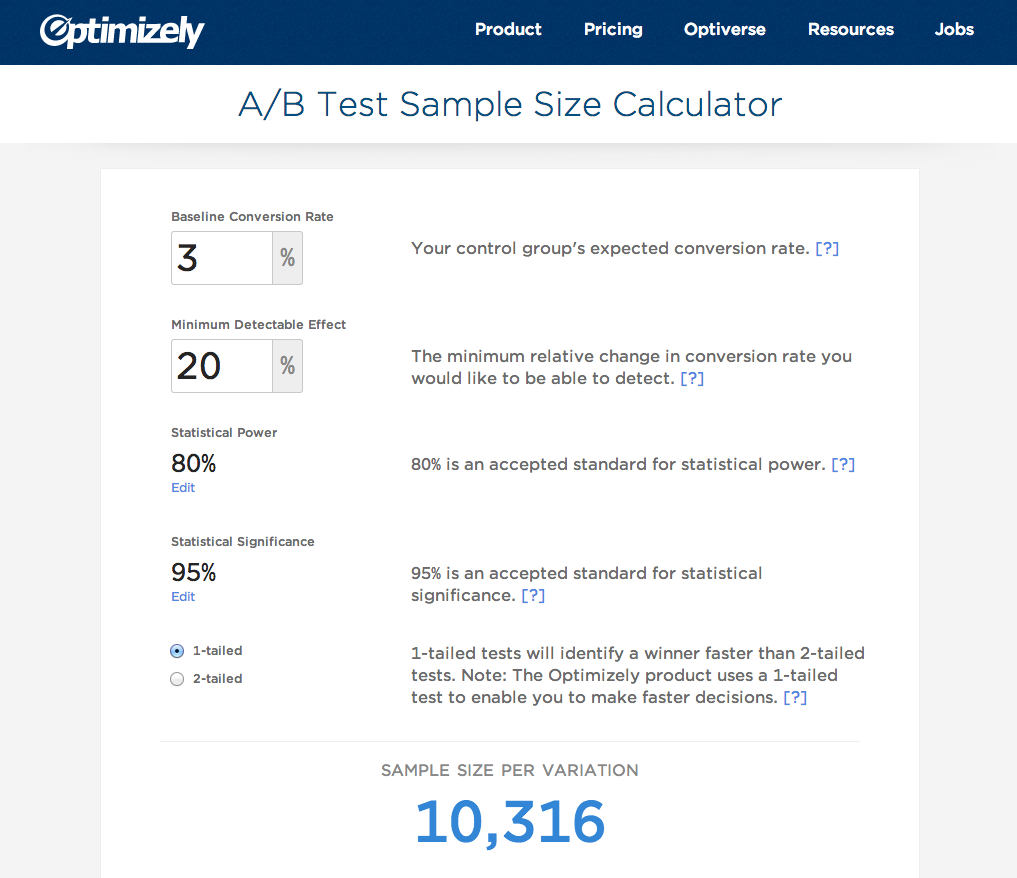
Optimizely just released a sample size calculator, which tells people how many visitors they need for an A/B test to get results. This page began as a hack week project, which produced a functioning page, but needed some design love before being ready for primetime. So my coworker Jon (a communication designer at Optimizely) and I teamed up to push this page over the finish line. In this post, I’m going to explain the design decisions we made along the way.
The finished sample size calculator
We Started with a Functioning Prototype
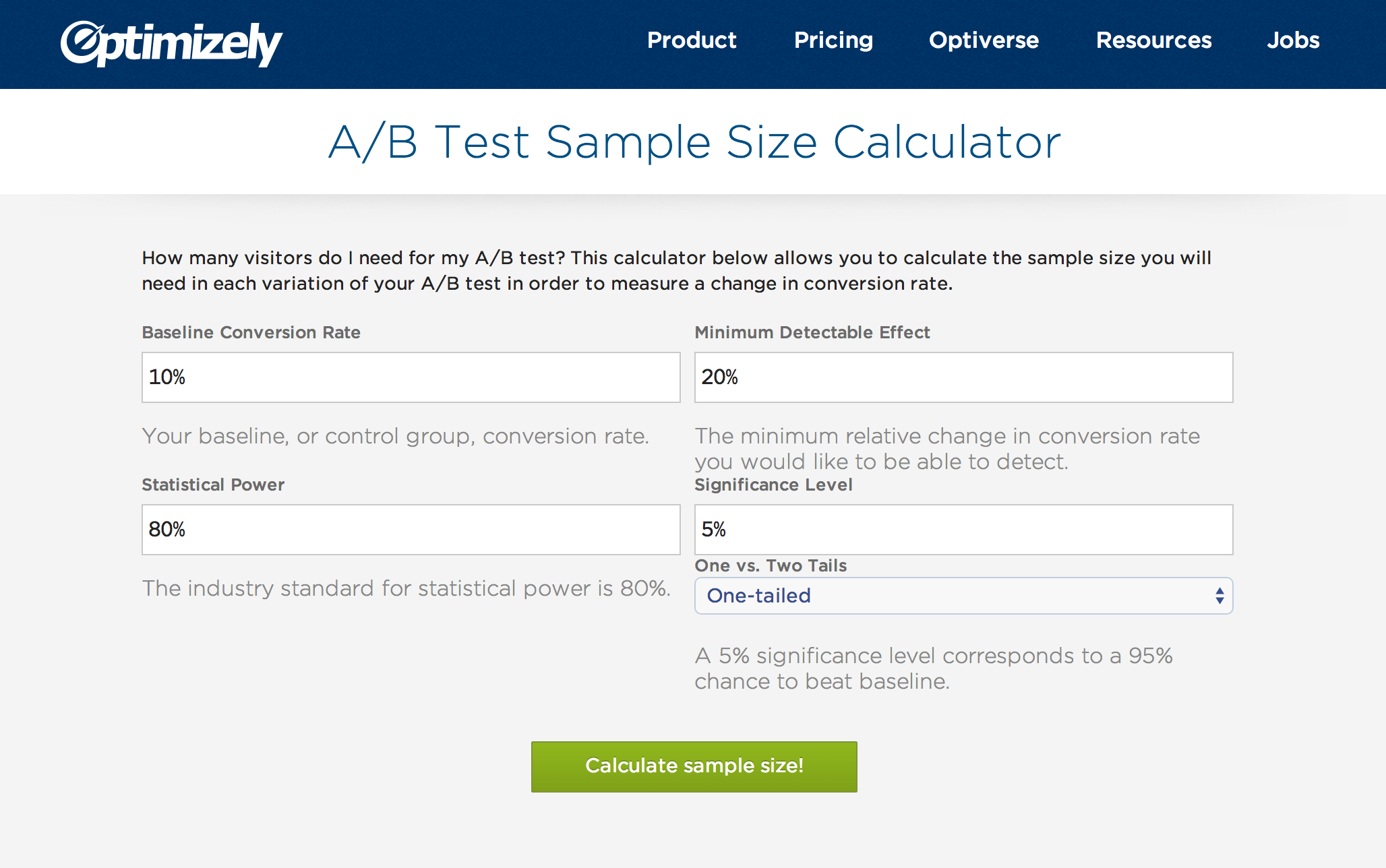
The page started as an Optimizely hack week project that functioned correctly, but suffered from a confusing layout that didn’t guide people through the calculation. After brainstorming some ideas, we decided the calculator’s layout should follow the form of basic math taught in primary school. You start at the top, write down each of the inputs in a column, and calculate the answer at the bottom.
The original sample size calculator prototype
This made sense conceptually, but put the most important piece of data (the number of visitors needed) at the bottom of the page. Conventional wisdom and design theory would say our information hierarchy is backwards, and users may not even see this content. It also meant the answer is below the fold, which could increase the bounce rate.
All of these fears make sense when viewing the page through the lens of static content. But this page is interactive, and requires input from the user to produce a meaningful answer to how many visitors are needed for an A/B test. Lining up the inputs in a vertical column, and placing the answer at the bottom, encourages people to look at each piece of data going into the calculation, and enter appropriate values before getting an answer. The risk of visitors bouncing, or not seeing the answer, is minimal. Although this is counter to best practices, we felt our reasons for breaking the rules were sound.
Even so, we did our due diligence and sketched a few variations that shuffled around the inputs (e.g. horizontal; multi-column) and the sample size per variation (e.g. top; sides). None of these alternates felt right, and having the final answer at the bottom made the most sense for the reasons described above. But sketching out other ideas made us confident in our original design decision.
Power User Inputs
After deciding on the basic layout of the page, we tackled the statistical power and significance inputs. We knew from discussions with our statisticians that mathematically speaking these were important variables in the calculation, but they don’t need to be changed by most people. The primary user of this page just wants to know how many visitors they’ll need to run through an A/B test, for whom the mathematical details of these variables are unimportant. However, the values should still be clear to all users, and editable for power users who understand their effect.
To solve this challenge, we decided to display the value in plain text, but hide the controls behind an “Edit” button. Clicking the button reveals a slider to change the input. We agreed that this solution gave enough friction to deter most users from playing around with these values, but it’s not so burdensome as to frustrate an expert user who wants to change it.
Removing the “Calculate” Button
The original version of the page didn’t spit out the number of visitors until the “Calculate” button was clicked. But once I started using the page and personally experienced the annoyance of having to click this button every time I changed the values, it was clear the whole process would be a lot smoother if the answer updated automatically anytime an input changed. This makes the page much more fluid to use, and encourages people to play with each variable to see how it affects the number of visitors their test needs.
This is a design decision that only became clear to me from using a working implementation. In a static mock, a button will look fine and come across as an adequate user experience. But it’s hard to assess the user experience unless you can actually experience a working implementation. Once I re-implemented the page, it was clear auto-updating the answer was a superior experience. But without actually trying each version, I wouldn’t have been confident in that decision.
Conclusion
This project was a fun cross-collaboration between product and communication design at Optimizely. I focused on the interactions and implementation, while Jon focused on the visual design, but we sat side-by-side and talked through each decision together, sketching and pushing each other along the way. Ultimately, the finished product landed in a better place from this collaboration. It was a fun little side project that we hope adds value to the customer experience.
Jeff Domke’s article about working on “unshiny” products sums up my view of my own work at Optimizely. The crux of his argument is that many designers are drawn to working on “shiny” products — products that are pretty and lauded in the design community — but “unshiny” products are a lot more interesting to work on. They’re often solving difficult problems, and have more room for you to make an impact. You’re working to make the product reach its potential. Shiny products, on the other hand, have reached that potential, and you are less able to make your mark.
Optimizely sits right in the sweet spot. We aren’t “shiny” (compared to sexy products like Square and Medium, we have a long way to go); nor are we “unshiny” (our customers describe us as well-designed and easy-to-use). Rather, we land more in the middle — we have a solid user experience that has a lot of room for improvement.
We’re also solving really hairy, complex problems. Apps that get mounds of praise tend to solve relatively simple problems (such as to-do list apps). It’s much more interesting to work on a problem space that is unexplored and is full of murky, vague, conflicting goals that must be untangled. And once you’ve made sense of the mess, you know you’ve enabled someone to do their job better.
And that’s the most exciting part of working at Optimizely — making the product fulfill its potential, and solving tough problems that impact businesses’ bottom lines.
I recently read Frank Chimero’s excellent article, “Designing in the Borderlands”. The gist of it is that we (designers, and the larger tech community) have constructed walls between various disciplines that we see as opposites, such as print vs. digital, text vs. image, and so on. However, the most interesting design happens in the borderlands, where these different media connect. He cites examples that combine physical and digital media, but the most interesting bit for me was his thoughts on roles that span disciplines:
For a long time, I perceived my practice’s sprawl as a defect—evidence of an itchy mind or a fear of commitment—but I am starting to learn that a disadvantage can turn into an advantage with a change of venue. The ability to cross borders is an asset. Who else could go from group to group and be welcomed? The pattern happens over and over: if you’re not a part of any group, you can move amongst them all by tip-toeing across the lines that connect them.
I have felt this way many times throughout my career (especially that “fear of commitment” part). I have long felt like a generalist who works in both design and engineering, and I label myself to help people understand what I do (not to mention the necessity of a title). But I’ve never cleanly fit into any discipline.
This line was further blurred by my graduate degree from UC Berkeley’s School of Information. The program brings together folks with diverse backgrounds, and produces T-shaped people who can think across disciplines and understand the broader context of their work, whether it be in engineering, design, policy & law, sociology, or dozens of other fields in which our alumni call home.
These borderlands are the best place for a designer like me, and maybe like you, because the borderlands are where things connect. If you’re in the borderlands, your different tongues, your scattered thoughts, your lack of identification with a group, and all the things that used to be thought of as drawbacks in a specialist enclave become the hardened armor of a shrewd generalist in the borderlands.
Couldn’t have said it any better. Being able to move between groups and think across disciplines is more of an advantage than a disadvantage.
This Happy Cog article by Stephen Caver perfectly encapsulates why we hire UI Engineers on the design team at Optimizely (as opposed to the engineering team). We want the folks coding a UI to be involved in the design process from the beginning, to understand the design system that underlies a user experience, and to be empowered to make design decisions while developing a UI. Successful designs must adapt to various contexts and degrade gracefully. The people most qualified to make those kinds of decisions are the ones writing the code. As said in the article, “In this new world, the best thing a developer can do is to acquire an eye for design—to be able to take design aesthetic, realize its essential components, and reinterpret them on the fly.” By embracing this mindset in our hiring and design process, we’ve found the end result is a higher quality product.
I just got around to watching Matthew Carter’s excellent TED talk, “My Life in Typefaces”. In it, he talks about his experience designing type for the past 5 decades, and how technical constraints influenced his designs. The central question he tries to answer is, “Does a constraint force a compromise? By accepting a constraint, are you working to a lower standard?” This is a question that comes up in every discipline, and with every technological change. Matthew Carter’s take on this subject is interesting because he’s experienced numerous technological changes, and has designed superb typefaces for all of them.
At first blush, it’s easy to conclude that constraints force designers to compromise their vision. But design isn’t produced in a vacuum, and ultimately must be realized through one or more mediums (print, screen, radio, etc.). Therefore, one must work within constraints to produce the best designs. To do so, designers must understand the technology that enables their designs to be experienced, be it code, the printing process, and so on. As Matthew Carter said in this talk, “I’m a pragmatist, not an idealist, out of necessity,” which is a valuable lesson that all designers should take to heart.