Notes from Make (Sneaky) Art
I recently read the book “Make (Sneaky) Art”, which is full of tips and tricks to build your sketching habit. The author, Nishant Jain, calls himself a “sneaky artist” because he was embarassed of his drawings and didn’t want people to know he was sketching, but over time he built up a sketching habit and style and shared his techniques in this book.
I’ve wanted to build more of a sketching habit, and do ocassional sketches (but they’re few and far between), and this book has helped lower the bar for me and given me some new tools to do it more frequently. So I wrote down these tips to reinforce them in my head and to refer back to.
Drawing Tips
Build a Curiosity Spiral
Start with what interests you, then build out from there.
Use Anchoring
Everything you draw helps you draw the next thing. What’s next to it? Looms over it or lies under it? Jump from one thing to the next.
Layers
Sketches have layers to them. Not all layers are in all drawings, but it’s useful to know what the layers are and use them in your drawings (or skip them entirel).
- Subject: Your point of curiosity
- Frame: Contains your subject (think of looking at a subject through a window; although you don’t need to be this literal)
- Extras: Context and extra details
Outside in
One way of getting a sketch down quickly is starting from the outside in: draw the outer profile and main aspects you notice before filling in details.
Go from course -> fine.
Think contours, long lines first -> light/shadow, details, etc.
(This runs a little contrary to “building a curiosity spiral”, which is more like “inside out”, but I look at these as techniques to pull from as needed, not an either/or or dogma)
Quick Challenges
These are a few challenges to spur you into sketching what you see.
- 5-minute sketch. Take a seat at a cafe, a park bench, etc., and set a timer for 5 minutes, then draw whatever grabs your interest until the timer goes off. The goal is to just finish a sketch, any sketch, in that time, without worry about the outcome or how “good” it is. To finish a sketch in this time, you’ll need to work quickly, so don’t overthink it and just make loose lines for whatever grabs your interest.
- Look for natural frames — trees overhanging an object of interest, door frames, architecture, etc.
- Filter in, filter out. Zoom in to focus on one part of a busy scene, then zoom out and ask yourself if it makes it better.
- Contrasts and interesting juxtapositions, like sharp light and shadows; people looking in opposite directions, and so on.
- Play with colors. E.g. try one color for your subject, and a different color for everything else.
Tips for drawing tiny people
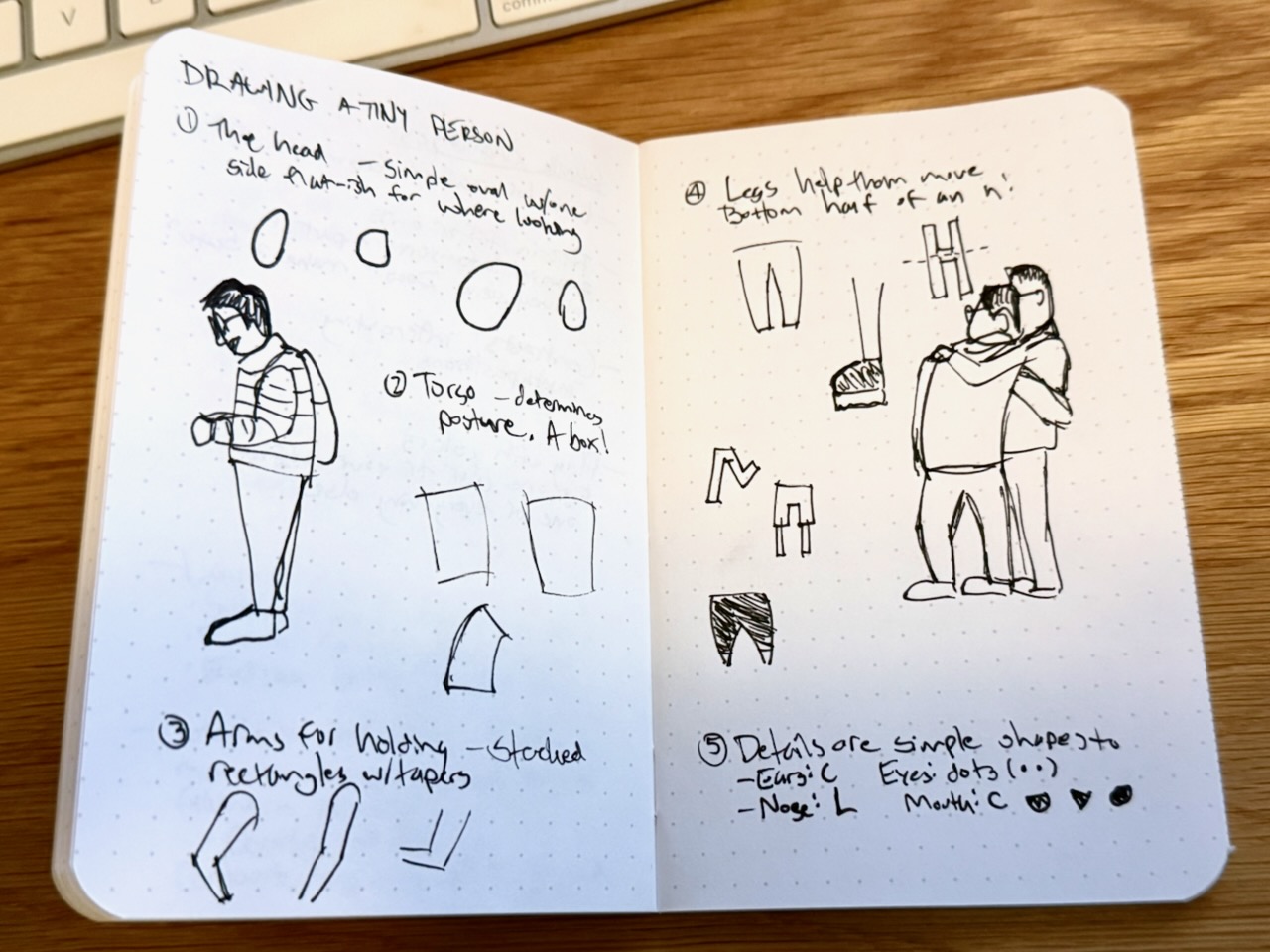
I really liked this section of simple tips to draw people, which to me feels intimidating and too complex, but this did a good job of breaking it down into a series of steps and simple shapes.
- The head: Draw a simple oval with one side flat-ish to indicate where they’re looking
- Torso: Draw a box! Make it angled to determine posture. Taper it, stretch it, skew it.
- Arms: Use stacked rectangles with tapers. Try to capture what they’re doing, holding, etc., to make them active and interesting.
- Legs: Basically the bottom half of an uppercase “H”. Or also some tapered rectangles. Also use these to capture movement and action.
- Details are simple shapes: Ears are a “C”. Eyes are dots. Nose is an “L”. Mouth is a “C” on its’ side, or a circle, half circle, etc.
If anyone uses these tips to build their sketching habit, let me know!